
How much does it cost to incorporate a company in France?
Incorporating a company in France costs between €1,500 and €5,000 in setup fees for a standard SAS or SARL, excluding the share capital you decide to inject. This budget covers the drafting of the articles of association, the legal publication notice, the registry filing and the professional fees of a firm like Keypoint that manages the file for you.
The registry filing fee at the Greffe du Tribunal de Commerce is fixed: around €37 for a commercial company (Infogreffe, 2025). The mandatory legal announcement in an authorised journal (JAL) costs between €120 and €200 depending on the region and the company form. Share capital for an SAS or SARL can legally start at €1, though foreign companies setting up in France usually inject between €1,000 and €37,000 to signal credibility to banks and partners.
Professional fees make up the largest share. A one-stop-shop firm that drafts the statutes, registers the entity and opens the bank file typically charges €1,500 to €3,500. Keypoint bundles company creation, legal setup and the first accounting steps under a single English-speaking contact, which removes the need to coordinate a separate notary, lawyer and accountant.
€1,500 – €5,000
Typical all-in setup cost for an SAS or SARL in France, excluding share capital (Keypoint estimate, 2026)
How long does it take to set up a company in France?
Setting up a company in France takes 1 to 4 weeks from the moment your file is complete, with registration itself processed in a few business days. The real variable is how fast you gather the required documents, not the administrative speed of the French registry.
Since the launch of the Guichet unique run by INPI in January 2023, all company formation formalities go through a single online portal (INPI, 2024). Once statutes are signed, capital is deposited and documents are filed, the Greffe usually issues the Kbis extract within 2 to 7 business days. The Kbis is the official proof that your entity legally exists in France.
Delays almost always come from upstream steps. Opening a French business bank account to deposit share capital can take 1 to 3 weeks for a foreign shareholder, because banks run enhanced due diligence on non-resident owners. Getting documents apostilled or sworn-translated in the country of origin also adds time. Keypoint anticipates these steps for US, Dutch, UK, Canadian and Swedish clients, which is where most of its incoming projects come from.
À retenir
- Registry issues the Kbis in 2 to 7 business days after a complete filing (Infogreffe, 2025)
- All formalities go through the INPI Guichet unique since January 2023
- Bank account opening for a foreign shareholder is the main bottleneck: 1 to 3 weeks
SAS, SARL or branch: which structure costs what?
An SAS or SARL subsidiary costs more to set up than a branch, but gives foreign companies a separate legal entity, limited liability and easier banking in France. The right structure depends on whether you want an independent company or an extension of your existing foreign entity.
The SAS (société par actions simplifiée) is the structure most foreign groups choose when they expand to France, thanks to its flexible governance and the single-shareholder SASU variant. The SARL suits smaller operations with a more rigid but reassuring framework. A branch (succursale) is not a separate entity: it extends the parent company’s liability into France, which lowers setup cost but increases legal exposure.
Keypoint advises foreign-owned companies on this choice during the first consultation, because the structure drives tax treatment, statutory auditor obligations and payroll compliance. France requires a statutory auditor (commissaire aux comptes) only above certain thresholds, so many new subsidiaries avoid that cost at launch.
| Criterion | SAS / SASU | SARL | Branch |
|---|---|---|---|
| Separate legal entity | Yes | Yes | No |
| Minimum capital | €1 | €1 | None |
| Typical setup cost | €1,500–€5,000 | €1,500–€4,000 | €1,000–€3,000 |
| Parent company liability | Limited | Limited | Full |
What hidden costs should foreign companies expect?
Beyond the €1,500 to €5,000 setup fee, foreign companies in France should budget for domiciliation, accounting, payroll and the first corporate tax filings. These recurring costs are often overlooked in the initial business plan and matter more than the one-off incorporation fee.
A registered business address (domiciliation) in France costs €30 to €120 per month if you use a commercial domiciliation provider instead of renting office space. Monthly bookkeeping for a small subsidiary starts around €150 to €500 depending on transaction volume. Payroll compliance adds a cost per employee per month once you hire your first staff in France.
Sworn translations of foreign corporate documents, notary fees for certain formalities and bank charges also add up. Keypoint lists these items transparently from the first quote so foreign-owned companies can plan a realistic 12-month budget rather than discovering costs after the Kbis is issued. For research-intensive businesses, the French Crédit d’Impôt Recherche (CIR) and the Jeune Entreprise Innovante (JEI) status can offset a meaningful part of these running costs. You can read more on official support schemes directly via the French Ministry of Economy’s CIR resource.
Domiciliation
€30 to €120 per month for a registered business address in France
Bookkeeping
From €150 to €500 per month for a small subsidiary
Payroll
Cost per employee per month once you hire staff in France
What documents do you need to register a company in France?
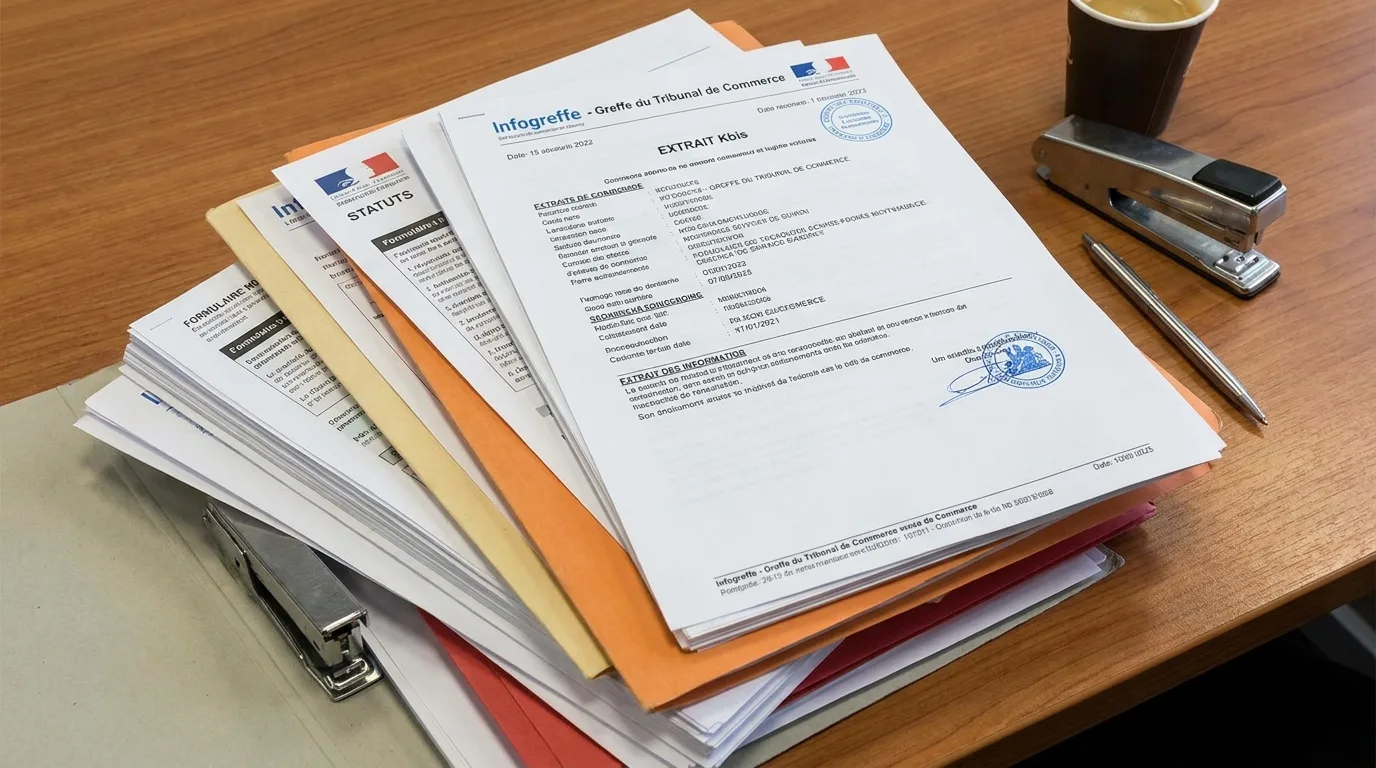
To register a company in France you need signed articles of association, proof of a registered address, a capital deposit certificate, identity documents for the directors and a declaration of beneficial owners. Foreign shareholders must often provide apostilled and translated versions of these documents.
The core file submitted to the INPI Guichet unique includes: the statutes signed by all shareholders, the attestation of capital deposit issued by the bank, a proof of domiciliation (lease or domiciliation contract), a copy of the director’s passport or ID, and a sworn declaration of non-conviction for the director. The register of beneficial owners (RBE) must also be filed.
For a foreign parent company opening a subsidiary or branch, additional documents apply: a recent extract of the parent company’s own registration, a board resolution approving the French setup, and sworn French translations of these documents. Keypoint prepares and reviews this full checklist before filing, which prevents the back-and-forth rejections that delay many self-managed applications. The official rules on required documents are published by the French public service portal for businesses.
How does Keypoint speed up company formation in France?
Keypoint speeds up company formation in France by acting as a single English-speaking contact that handles the legal setup, bank file, accounting and tax registration in parallel instead of one after another. This one-stop-shop model is the main reason foreign companies complete their incorporation in weeks rather than months.
Keypoint International (formerly VM International) has specialised exclusively in foreign-owned companies in France since 2003. Its team of 15 collaborators manages the entire sequence: structure advice, drafting of statutes, capital deposit, INPI filing, then the first VAT and corporate tax registrations. Because the same firm also keeps your books afterwards, nothing is lost in handovers between separate providers.
The firm mobilises a network of partners for steps it does not handle directly, such as an English-speaking notary, specialised lawyers and banking contacts used to non-resident shareholders. For clients coming from the US, the Netherlands, the UK, Canada and Sweden, this interpreter role across legal, tax and banking cultures removes the friction that usually slows down a French setup. As an independent firm of human scale, Keypoint also gives direct access to its partners, which keeps decisions fast. Its tagline sums up the approach: “We make France work for your business”.
Ce que disent nos clients
Keypoint affiche une note moyenne de 5,0/5 sur 5 avis clients vérifiés, en particulier sur l’accompagnement à l’implantation en France.
”Cabinet très professionnel, à l’écoute et réactif. Un accompagnement de grande qualité, notamment pour l’implantation de notre structure en France. Un grand merci à David pour ses précieux conseils.”
— Charles★★★★★ 5/5
”Travailler avec ce cabinet comptable a été une expérience très positive pour notre entreprise. L’équipe est non seulement compétente et réactive, mais également très à l’écoute. Leurs conseils clairs et précis nous ont aidés à avancer en toute confiance, et leur accompagnement personnalisé fait vraiment la différence. Je recommande ce cabinet à toute structure, grande ou petite, qui cherche un partenaire de confiance.”
— Sera DUFOI GUDENYAN★★★★★ 5/5
”Très satisfait de l’accompagnement du cabinet. L’équipe est professionnelle, réactive et toujours à l’écoute. Les conseils sont clairs, pertinents et nous aident à prendre les bonnes décisions pour développer notre activité. Un partenaire fiable que je recommande sans hésitation.”
— Dr Morgan CHICHEPORTICHE★★★★★ 5/5
”Excellente expérience avec ce cabinet. L’équipe est agréable, à l’écoute, compétente et surtout, réactive ! Satisfaction totale Je recommande vivement”
— Raphaelle E★★★★★ 5/5
”Apres de nombreuses déceptions…J’ai été très sensible à l’accueil ,et l’écoute de ce Cabinet qu’on m’avait recommandé qui m’a soutenu dans l’aboutissement de mon projet”
— laurent paris★★★★★ 5/5