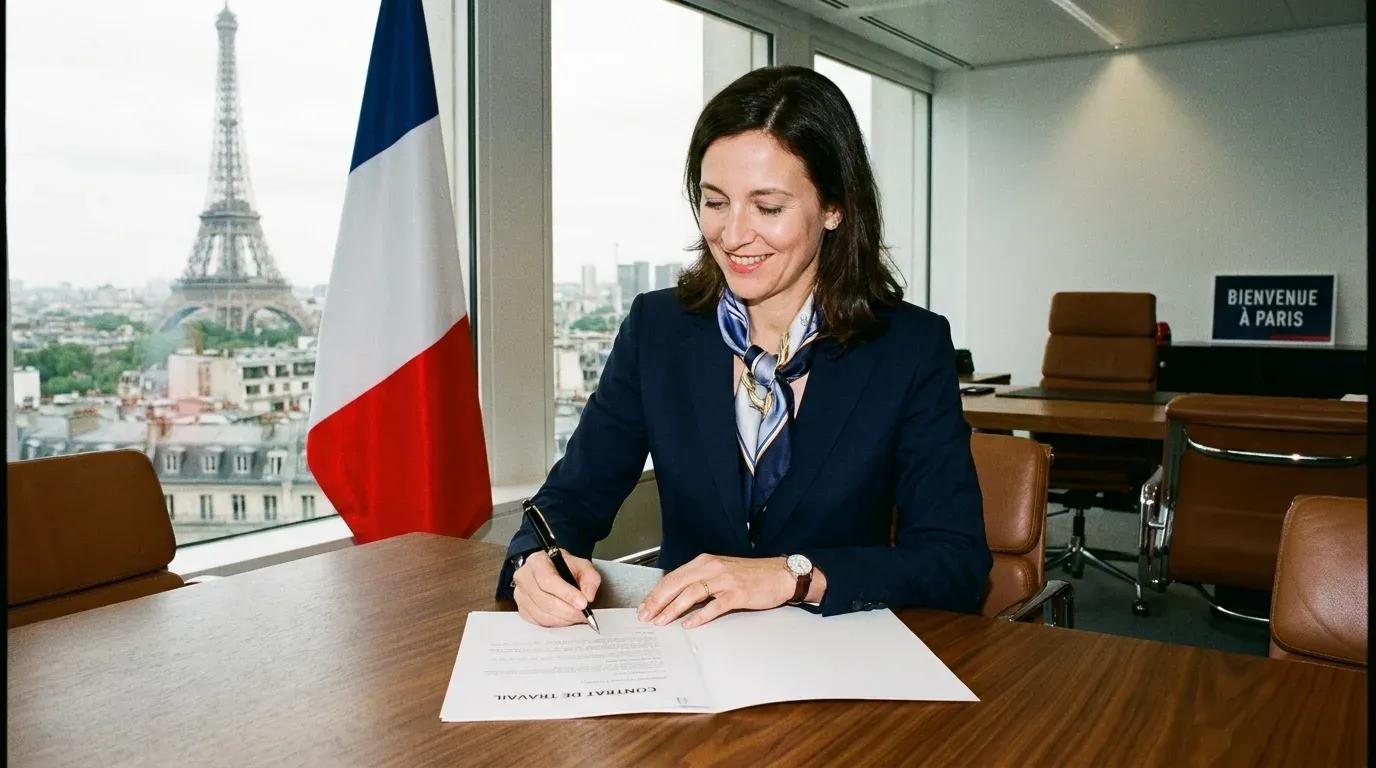
Can you hire in France without a legal entity?
Yes, a foreign company can legally hire an employee in France without a subsidiary or branch, using either a direct “foreign employer without establishment” registration or an Employer of Record. French labour law does not require an incorporated entity to employ someone on French soil. What it requires is a registered employer, a compliant employment contract, and correct payment of social contributions.
France counted around 3.4 million employees working for companies with foreign ownership (Insee, 2022). Many foreign groups test the market with one or two hires before committing to a full structure. Two routes make this possible. The first is registering your foreign company directly as an employer with French social bodies. The second is delegating the employment to an Employer of Record that already holds a French entity.
Both routes give the employee a French contract, French payslips, and full coverage under the French social security system (Sécurité sociale). The difference lies in who signs the contract and who carries the legal risk. At Keypoint, an accounting and advisory firm in France dedicated to foreign-owned companies, we see this question weekly from US, Dutch, UK, Canadian and Swedish groups. The right answer depends on your headcount plans, your budget, and how much control you want over the employment relationship.
~3.4 M
employees in foreign-owned companies operating in France (Insee, 2022)
What is a “foreign employer without establishment” in France?
A “foreign employer without establishment” is a company registered abroad that employs staff in France directly, without creating a French entity, by registering with French social security bodies. This status is set out in the French Social Security Code and administered through a dedicated service called the URSSAF service firmes étrangères (based in Strasbourg).
Under this route, your foreign company signs a French employment contract directly with the worker. You register with URSSAF and receive a SIRET-type identifier used to declare and pay contributions. The employee stays on your foreign payroll structure legally, but their social contributions flow into the French system: health, retirement, unemployment, and family benefits.
The employer must also appoint or arrange local payroll processing, since French payslips follow strict rules under the Code du travail. You remain the legal employer, which means you carry the obligations: monthly social declarations (DSN, the Déclaration Sociale Nominative), collective bargaining agreement compliance, and the 35-hour working week framework. Missing a declaration triggers penalties from URSSAF.
This model works well when a foreign company wants full control over the employee and plans to keep the relationship long term. Keypoint handles this registration and the ongoing French payroll for foreign employers across France, so the company stays compliant without a local office. For details on the payroll side, see our payroll management and HR consulting services. Official guidance is published by URSSAF for foreign employers.
How does an Employer of Record work in France?
An Employer of Record (EOR) is a French company that legally employs your worker on your behalf, handling the contract, payroll and compliance while the employee works day-to-day for you. The EOR becomes the legal employer; your company pays the EOR a fee plus salary costs.
This route removes the need for you to register anything in France. The EOR already holds a French entity and a payroll infrastructure. It signs the French contract, issues compliant payslips, pays URSSAF contributions, and manages the DSN declarations. You keep operational control over the employee’s tasks and objectives, but not the legal employment relationship.
EOR fees typically run between 8% and 15% of gross salary, or a fixed monthly amount, depending on the provider. It suits companies that want speed. An EOR can often onboard an employee in France within one to two weeks, versus several weeks to register directly or months to incorporate a subsidiary.
The trade-off is cost and distance. Over time, EOR fees add up, and you have less direct control over contract terms. French law also limits how long some arrangements can run before authorities may reclassify the setup. Keypoint advises foreign companies on whether an EOR fits their timeline or whether direct registration is more economical. When headcount grows, we help clients transition from an EOR to their own structure through our subsidiary and branch creation service.
Which option should a foreign company choose?
Direct registration suits foreign companies planning long-term hires who want control and lower running costs; an EOR suits fast, short-term or single hires where speed matters more than fee efficiency. The choice hinges on headcount, timeline, and appetite for administration.
The table below compares the three main paths for a foreign company hiring in France, based on the criteria Keypoint reviews with each client.
| Criterion | Foreign employer (direct) | Employer of Record | Subsidiary / branch |
|---|---|---|---|
| Setup time | 2 to 6 weeks | 1 to 2 weeks | 4 to 12 weeks |
| Legal employer | Your foreign company | The EOR | Your French entity |
| Running cost | Payroll + advisory fees | 8–15% of gross salary | Accounting + tax filing |
| Control over contract | Full | Limited | Full |
| Best for | 1–5 long-term hires | Single or short-term hire | Growing local operations |
For a single sales representative on a six-month trial, an EOR often wins on speed. For a team you intend to keep and expand, direct registration or a subsidiary usually costs less over 18 months. Keypoint models the total cost of each path for the specific salary and headcount, so foreign companies pick with real numbers rather than assumptions. Our consulting and support team runs these comparisons.
What are the payroll costs and obligations in France?
Employer social contributions in France add roughly 40% to 45% on top of gross salary, and every employer must file the monthly DSN declaration whatever route they use. These charges fund health, pensions, unemployment and family benefits, and they apply equally to a foreign employer without establishment and to an EOR.
For a gross salary of 50,000 euros, total employer cost typically lands near 70,000 euros once contributions are added. The exact rate depends on salary level, sector, and the applicable collective bargaining agreement (convention collective). Some contributions taper for lower salaries under the general reduction mechanism.
Beyond contributions, a French employer must issue compliant payslips, respect the 35-hour statutory week, grant a minimum of five weeks of paid holiday per year, and follow the sector’s collective agreement on minimum pay and notice periods. The minimum wage (SMIC) stood at 1,801.80 euros gross per month in 2025 (Service-Public.fr, 2025).
À retenir
- Employer contributions add around 40–45% to gross salary in France.
- The monthly DSN declaration is mandatory for every employer, entity or not.
- Employees get at least 5 weeks of paid holiday and a 35-hour reference week.
Payroll errors in France are costly: incorrect DSN filings expose the employer to URSSAF penalties and back-payments. Keypoint runs French payroll for foreign companies with no local finance team, covering payslips, declarations, and social filings. See our accounting and financial statements service for the bookkeeping side. Contribution rules are detailed by Service-Public.fr.
When should you set up a legal entity instead?
You should set up a French entity when you plan several hires, sign local contracts, hold French assets, or when your activity in France becomes a permanent establishment for tax purposes. Hiring without an entity is a starting point, not a permanent solution for a growing operation.
French and international tax rules treat a fixed place of business, or a person who habitually concludes contracts in France, as a “permanent establishment” (établissement stable). Once that threshold is crossed, your company may owe corporate tax in France on the profit attributed there, regardless of whether you registered a subsidiary. Hiring a salesperson who signs deals locally can trigger this.
A subsidiary (filiale) or branch (succursale) also becomes worthwhile when running costs of an EOR outgrow the cost of a local structure, usually past three to five employees. An entity gives you a French bank account, the ability to invoice locally, VAT registration, and access to schemes such as the Crédit d’Impôt Recherche (CIR) for R&D activity.
Keypoint acts as a one-stop-shop for this transition: company creation, domiciliation, accounting, tax and payroll under one roof, in English. We advise foreign groups on the permanent establishment risk before it becomes a tax problem through our tax compliance service and our doing business in France guide. The goal is simple, as our tagline puts it: we make France work for your business.
How Keypoint supports foreign employers in France
Keypoint is an accounting and advisory firm in France that works exclusively with foreign-owned companies, offering payroll, registration, tax and entity setup through a single English-speaking contact. Founded in 2003 as VM International, the firm has 23 years of focus on international groups entering France.
The team of 15 collaborators handles the full path: registering a foreign employer with URSSAF, running compliant French payroll, advising on EOR versus direct hire, and later creating a subsidiary or branch when growth justifies it. Because Keypoint is an independent firm of human scale, foreign companies get direct access to partners and competitive pricing, without navigating a large-firm hierarchy.
One-stop-shop
Registration, payroll, accounting, tax and legal under one roof, in English.
23 years of focus
Serving foreign groups in France since 2003, formerly VM International.
EN-first team
Clients from the US, Netherlands, UK, Canada and Sweden, served in English.
Keypoint covers France as a whole, not only Paris, and mobilises a network of partners such as English-speaking notaries and specialised lawyers when a client needs them. Whether you start with a single hire or plan a full subsidiary, Keypoint keeps the setup compliant. Learn more about the firm or contact the Keypoint team.
Ce que disent nos clients
Keypoint holds a verified rating of 5.0/5 based on 5 client reviews. Several clients specifically mention support for setting up their structure in France.
”Cabinet très professionnel, à l’écoute et réactif. Un accompagnement de grande qualité, notamment pour l’implantation de notre structure en France. Un grand merci à David pour ses précieux conseils.”
— Charles★★★★★ 5/5
”Travailler avec ce cabinet comptable a été une expérience très positive pour notre entreprise. L’équipe est non seulement compétente et réactive, mais également très à l’écoute. Leurs conseils clairs et précis nous ont aidés à avancer en toute confiance, et leur accompagnement personnalisé fait vraiment la différence. Je recommande ce cabinet à toute structure, grande ou petite, qui cherche un partenaire de confiance.”
— Sera DUFOI GUDENYAN★★★★★ 5/5
”Très satisfait de l’accompagnement du cabinet. L’équipe est professionnelle, réactive et toujours à l’écoute. Les conseils sont clairs, pertinents et nous aident à prendre les bonnes décisions pour développer notre activité. Un partenaire fiable que je recommande sans hésitation.”
— Dr Morgan CHICHEPORTICHE★★★★★ 5/5
”Excellente expérience avec ce cabinet. L’équipe est agréable, à l’écoute, compétente et surtout, réactive ! Satisfaction totale Je recommande vivement”
— Raphaelle E★★★★★ 5/5