- News
- ·
Oct 26, 2026
- ·
Reviewed On Oct 30, 2026
The Annual Compliance Calendar for a French Subsidiary
Every date a French subsidiary has to meet in a year, month by month: corporation tax instalments, the return and balance, the local business tax, approving and filing the accounts, and the monthly VAT and payroll filings.

David Jian
Partner · Chartered Accountant

In short
A French subsidiary with a 31 December year-end pays corporation tax in four instalments on 15 March, 15 June, 15 September and 15 December, files its tax return by the second working day after 1 May, and pays the balance by 15 May. The local business tax, the CFE, takes an instalment on 31 May where last year’s bill reached €3,000, with the rest falling due from 1 December. The shareholder approves the annual accounts within six months of the year-end, and they are filed at the commercial court registry within one month of approval, or two months online. Those filed accounts are public, and a company belonging to a group cannot use the confidentiality option open to some small companies. VAT and payroll are filed monthly. A newly created company pays no instalments in its first financial year. Filing late adds 10% to the tax due, rising to 40% after a formal notice.
A French subsidiary files more often than most foreign parents expect. To many accountants’ disdain, the dates are set by law rather than by your group’s reporting calendar, and the penalties for missing them are automatic.
Most of the year is relatively stable, except two workload peaks: October-November (preparation for the tax season) and March-June (tax filing season). It is then when the tax return, the tax balance, the local tax instalment and the approval of your annual accounts all land within six weeks of each other. Plan for that stretch with your advisor well and the rest of the year will look smooth.
The year at a glance
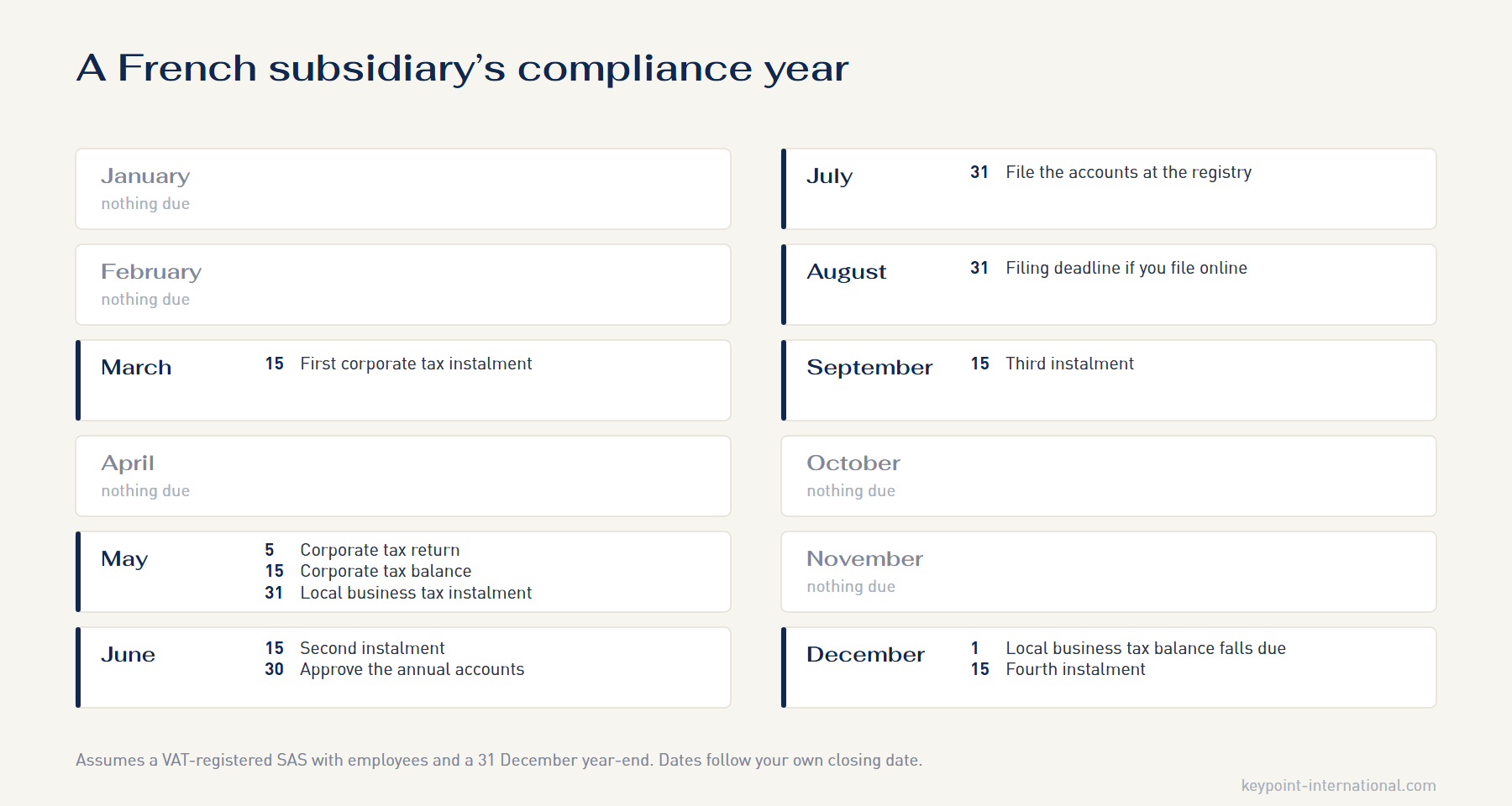
Everything below assumes the most common set-up: a simplified joint-stock company (société par actions simplifiée, or SAS) that is registered for VAT, employs people, and closes its financial year on 31 December. If your year-end is different, there is a section on that further down.
Corporation tax: four payments and one return
You pay French corporation tax in four instalments across the year, then settle the difference afterwards. Article 1668 of the Tax Code fixes the instalment dates at 15 March, 15 June, 15 September and 15 December. Each one is calculated from the profit of your last closed financial year, so the amount does not move if this year turns out better or worse than the last.
The return itself is called the liasse fiscale. Article 223 gives you three months from your year-end to file it. Companies closing on 31 December get a different rule: the second working day after 1 May, which in practice falls in the first week of May.
The balance of the tax is then due on the fifteenth day of the fourth month after your year-end. For a December close, that is 15 May.
The local business tax that catches people out
France charges a local business tax on top of corporation tax, the cotisation foncière des entreprises, usually shortened to CFE. It is calculated from the rental value of your premises, which means you can owe it even in a year when you lose money.
Article 1679 quinquies sets two dates. An instalment of half of last year’s bill is due on 31 May, and only if last year’s bill came to €3,000 or more. The rest falls due from 1 December.
This bill is published in your online tax account, and the responsibility for going to look at it is yours - or your advisor’s, if you have one.
Approving the accounts, and then filing them
These are two separate steps with two separate deadlines, and foreign parents often treat them as one.
First the shareholder approves the annual accounts. For a single-shareholder SAS, which is what most foreign groups own, Article L227-9 of the Commercial Code allows six months from the year-end. For a December close, that is 30 June.
The accounts are then filed at the commercial court registry (greffe du tribunal de commerce). Article L232-23 gives you one month from approval, or two months if you file electronically. That makes 31 July, or 31 August if you file online.
Once filed, your accounts are public, and anyone can download them. French law lets some small companies keep part of their accounts private, but Article L232-25 closes that door for you: a company belonging to a group cannot use it. If your French company has a foreign parent, its profit and loss account will be public and there is no way around that.
If your year-end is not 31 December
Some of these dates move with your year-end and some do not.
The ones that move are tied to your closing date: the return three months after it, the balance on the fifteenth of the fourth month after it, approval of the accounts within six months, and filing within one month of approval, or two months online.
The four instalment dates stay where they are, on 15 March, June, September and December, whatever your year-end. However, what changes even for those dates is which financial year each payment belongs to.
Every month: VAT and payroll
Another two filings repeat all year and never appear on an annual calendar, which is why they are easy to forget when you plan.
The VAT return, form CA3, is monthly. The exact day falls between the 15th and the 24th and depends on your company type and your registration number, so check your own date rather than assuming a common one. If you owe less than €4,000 of VAT across a year you can move to quarterly filing.
Payroll is reported through a single monthly payroll declaration, the déclaration sociale nominative, or DSN. It replaced almost every separate payroll declaration France used to require. It falls due on either the 5th or the 15th of the following month, depending on how many people you employ. What an employee costs sets out the contributions behind it.
Your first year works differently
A newly created company pays no corporation tax instalments during its first financial year. Article 1668 says so directly, and the reason is practical: there is no closed year to calculate them from. Your first payment is the balance, after you file your first return.
Note that for your cash flow planning. For example, a company incorporated in March 2026 and closing on 31 December pays no French corporation tax at all until May 2027.
What a missed deadline costs
Filing late adds 10% to the tax due. If the administration sends a formal notice (mise en demeure) and you still do not file within thirty days, that rises to 40%. Article 1728 sets both figures, along with 80% where an activity was never declared at all.
Late payment is penalised separately from late filing, so filing on time does not protect you if the money arrives late.
Where this leaves you
Put the four instalment dates into your group calendar first, then block out March-June as a busy period for your accountants, then stop worrying until the autumn. The pattern repeats every year, and the only part that regularly changes is your own year-end.
If you would like to inquire about your case in France to local experts, feel free to contact KeyPoint International - we are supporting foreign businesses in France in their incorporation and success since 2003.
Key takeaways
- Corporation tax is paid in four instalments, on 15 March, 15 June, 15 September and 15 December, each calculated from your last closed year
- March to June is the crunch: the return, the tax balance, the CFE instalment and the approval of the accounts all land within six weeks
- A company belonging to a group cannot keep its accounts confidential, so a foreign-owned subsidiary always publishes its profit and loss account
Frequently asked questions
When is the French corporation tax return due?
The return, called the liasse fiscale, is due three months after your year-end. Companies closing on 31 December follow a different rule: the second working day after 1 May, which in practice falls in the first week of May.
When are French corporation tax instalments paid?
On 15 March, 15 June, 15 September and 15 December. Each instalment is calculated from the profit of your last closed financial year, so the amount does not move if the current year turns out better or worse.
Does a new French company pay corporation tax instalments in its first year?
No. A newly created company pays no instalments during its first financial year, because there is no closed year to calculate them from. Your first payment is the balance, after you file your first return. Note that for your cash flow.
When is the CFE business rates bill due in France?
An instalment of half of last year’s bill falls due on 31 May, and only where last year’s bill came to €3,000 or more. The rest falls due from 1 December. The bill is published in your online tax account rather than posted to you.
When must a French subsidiary approve and file its annual accounts?
These are two steps. The shareholder approves the accounts within six months of the year-end, so 30 June for a December close. They are then filed at the commercial court registry within one month of approval, or two months if you file online.
Can a French subsidiary keep its accounts confidential?
Not if it belongs to a group. French law lets some small companies keep part of their accounts private, but article L232-25 of the Commercial Code closes that door to group companies. If your French company has a foreign parent, its accounts are public.

About the author
David Jian
Partner · Chartered Accountant
David Jian is a partner at Keypoint International, a chartered accountant and Canadian CPA. He advises international groups on setting up and running their operations in France, drawing on senior roles at PwC and Deloitte and management experience across Asia, the Americas and Europe.
A question? A project? Let's talk!
Our team supports you at every step of your establishment and growth in France. Let's discuss your needs.

Benjamin Chemoul & David Jian
Partners & Certified Public Accountants