- News
- ·
Oct 07, 2026
- ·
Reviewed On Oct 30, 2026
How Much Does an Employee Cost in France? Employer Contributions Explained (2026 + 2027 Outlook)
A €2,500 salary costs an employer about €3,116 a month. A €4,000 salary costs €5,515. Worked examples of French employer contributions in 2026, the relief that sets the rate you pay, and what the 2027 budget would change.

David Jian
Partner · Chartered Accountant

In short
In 2026 a French employee pays about 20.8% of gross in social contributions, and the employer pays about 41.8% before relief. The single degressive general reduction (réduction générale dégressive unique) then cuts the employer side, by up to 39.81% of gross at the minimum wage, tapering to nothing at three times the minimum wage (€5,469 a month, because the reference minimum wage is frozen at its 1 January 2026 value). A €2,500 gross salary therefore costs an employer about €3,116 a month, an effective employer rate of 24.6%, while a €4,000 salary costs about €5,515, or 37.9%. Budget roughly 1.25 times gross at €2,500 and 1.38 times at €4,000. The 2027 budget bills, presented on 1 October 2026 and not yet voted, would count salary supplements towards the relief calculation, cutting relief by €3.7 billion, without changing the relief’s parameters.
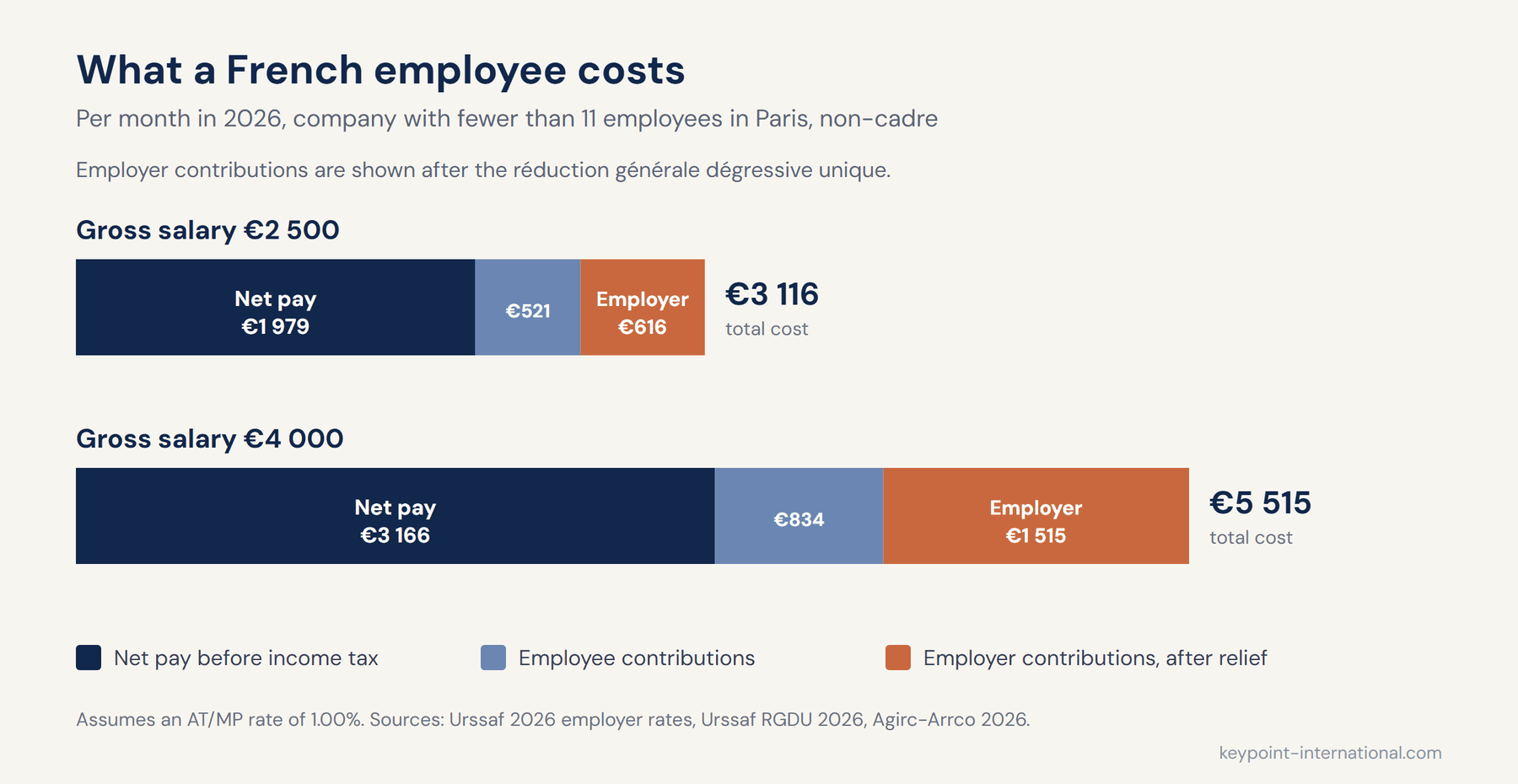
A French salary carries three different numbers, and foreign employers routinely budget with the wrong one. Offer someone €2,500 a month and they take home about €1,979. You pay about €3,116. And the gap does not scale the way people expect: raise the salary to €4,000 and the employer’s share climbs from 24.6% to 37.9% of gross.
What the employee pays
Start with the side the candidate sees. Out of a €2,500 gross salary, employee contributions take about €521, or 20.8%, leaving roughly €1,979. That covers old-age pension, the mandatory complementary pension, and the two levies that fund health cover and social debt: the general social contribution (contribution sociale généralisée, or CSG) and the social debt repayment contribution (contribution au remboursement de la dette sociale, or CRDS).
Two things here surprise foreign employers. Employees pay no unemployment contribution at all, because that was moved entirely to the employer in 2018. And income tax comes off the payslip on top of those figures, under the withholding system (prélèvement à la source), at a rate the tax office sends you for each employee.
The employee share is close to flat, so at €4,000 it is still 20.8%, or €834. All the movement is on the employer side.
What the employer pays
Employer contributions are roughly a dozen separate charges, collected by two bodies. The social security collection agency (Urssaf) takes health, pension, family, unemployment, autonomy, housing, training and apprenticeship levies. The mandatory complementary pension scheme (Agirc-Arrco) takes its own on top.
| Contribution | Rate | Base |
|---|---|---|
| Health, maternity, invalidity, death | 13.00% | All pay |
| Old-age pension, uncapped | 2.11% | All pay |
| Old-age pension, capped | 8.55% | Up to €4,005/month |
| Family allowances | 5.25% | All pay |
| Unemployment insurance | 4.00% | Up to €192,240/year |
| Wage guarantee (AGS) | 0.25% | Up to €192,240/year |
| Autonomy solidarity contribution (CSA) | 0.30% | All pay |
| Housing levy (Fnal, under 50 employees) | 0.10% | Up to €4,005/month |
| Workplace accidents (AT/MP) | Set per establishment | All pay |
| Training and apprenticeship levies | 1.23% | All pay |
| Complementary pension and general balance contribution (CEG), band 1 | 6.01% | Up to €4,005/month |
For a small company in Paris these come to about 41.8% of gross, and that share barely moves with salary, because most of the rates are flat.
The reduction that does most of the work
On 1 January 2026 the three reliefs that used to sit side by side, the old general reduction plus the reduced sickness and family-allowance rates, were merged into one: the single degressive general reduction (réduction générale dégressive unique, or RGDU). The reduced rates are gone for ordinary employers, so sickness is now 13% and family allowances 5.25% for everyone, and the relief arrives as a single degressive reduction instead.
For an employer with fewer than 50 employees it is worth up to 39.81% of gross at minimum-wage level, and it tapers to nothing at three times the minimum wage (salaire minimum interprofessionnel de croissance, or SMIC):
Coefficient = 0.0200 + 0.3781 x [ 0.5 x ( (3 x annual SMIC / annual gross) - 1 ) ] ^ 1.75

(0.3821 and a 40.21% maximum for employers with 50 or more employees)
Two details catch people out. The minimum wage in that formula is frozen at its 1 January 2026 value of €1,823.03, while the minimum wage itself rose to €1,867.02 on 1 June. The relief therefore runs out at €5,469 a month, which is 2.93 times today’s minimum wage rather than three. And the calculation runs on annual pay, so a December bonus reduces the relief for the whole year, retroactively.
The effective employer rate, from the minimum wage to €5,000
Because the relief tapers, the employer rate is a curve rather than a number. Same company, same rates, eight salary levels:
| Gross salary | Before relief | Relief | After relief | Employer rate | Total cost |
|---|---|---|---|---|---|
| €1,867 (minimum wage) | €781 | €700 | €81 | 4.3% | €1,948 |
| €2,000 | €836 | €629 | €207 | 10.3% | €2,207 |
| €2,500 | €1,045 | €430 | €616 | 24.6% | €3,116 |
| €3,000 | €1,254 | €300 | €955 | 31.8% | €3,955 |
| €3,500 | €1,464 | €214 | €1,250 | 35.7% | €4,750 |
| €4,000 | €1,673 | €158 | €1,515 | 37.9% | €5,515 |
| €4,500 | €1,809 | €124 | €1,685 | 37.4% | €6,185 |
| €5,000 | €1,945 | €109 | €1,836 | 36.7% | €6,836 |
The rate peaks near €4,000 and then eases slightly, because the capped pension and housing levies stop at the monthly ceiling of €4,005 while the salary keeps rising.
Examples
€2,500 a month
Gross contributions come to €1,045. The relief coefficient at this level is 0.1719, worth €430 a month, which leaves €616 for the employer. Total cost: €3,116, against net pay of €1,979 before income tax. You pay 1.57 times what the employee receives.
€4,000 a month
The rates are identical, so gross contributions scale straight up to €1,673. The relief does not. At this salary the coefficient falls to 0.0395, worth €158. The employer is left with €1,515, and the total cost is €5,515 against net pay of €3,166. Now you pay 1.74 times what the employee receives.
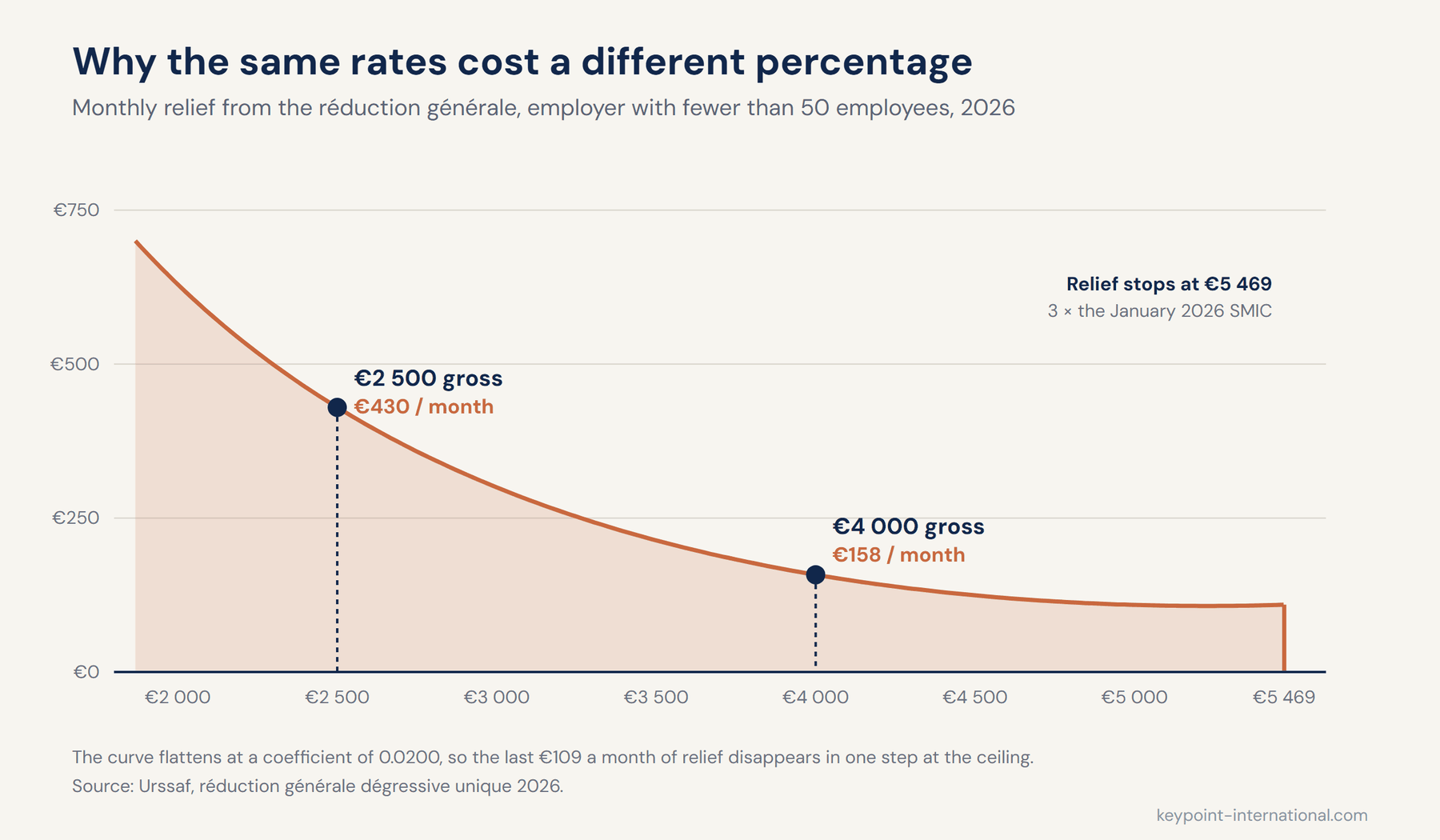
Nothing in the contribution rates changed between those two cases. The entire difference, 24.6% against 37.9%, comes from the taper.
The taper ends with a step rather than a fade. Just below the ceiling the coefficient stops falling at 0.0200, so a salary of €5,469 still carries about €109 a month of relief and one of €5,470 carries none.
What moves these numbers
Four things shift the figures above:
- Eleven employees: the training levy goes from 0.55% to 1%, and the transport levy (versement mobilité) starts. In the Paris region that one is worth up to roughly 3% of payroll on its own.
- Fifty employees: the housing levy (fonds national d’aide au logement, or Fnal) goes from 0.10% of capped pay to 0.50% of all pay, and a works council becomes mandatory.
- Your workplace-accident rate: cover against accidents at work and occupational illness (accidents du travail et maladies professionnelles, or AT/MP) is set per establishment by the regional social security fund (Carsat) and depends on your sector. An office rate near 1% is normal; industrial rates run several times higher.
- Managerial status (cadre): managerial staff add the executive employment agency levy (Association pour l’emploi des cadres, or APEC) and a 1.50% death-and-disability contribution on the first ceiling band. Mandatory private health cover, at least half paid by the employer, applies to everyone.
What do we expect in 2027?
The 2027 finance and social security bills (projet de loi de finances and projet de loi de financement de la sécurité sociale, or PLF and PLFSS) were both presented on 1 October 2026. The social security bill has had a rough passage since: the National Assembly (Assemblée nationale) rejected it on 23 October 2026, so it goes to the Senate (Sénat) in its original wording. The finance bill is still before the Assembly. None of this is law yet, and the figures below can move in debate or fall away altogether.
The measure that matters for payroll concerns the general reliefs. The government’s press dossier says the bill normalises how salary supplements count towards the pay used to calculate the relief coefficient, and puts the effect at €3.7 billion less relief. The stated reason is to stop two employees on the same total pay attracting different relief because their pay is made up differently.
The dossier is explicit on two points. The parameters of the relief itself do not change, so the formula and the three-times-minimum-wage ceiling stay as they are. And the favourable treatment of profit-sharing (intéressement), employee participation and employer top-ups to savings plans is untouched; what changes is how those amounts count when the relief is worked out.
The same measure makes the value-sharing bonus (prime de partage de la valeur) regime permanent, rather than letting it lapse on 31 December 2026, and extends its exemption from the two social levies by a further year for companies under 50 employees.
One thing the dossier does not say is whether the freeze on the reference minimum wage continues into 2027. Until the final text is voted, budget on the 2026 scale.
What to budget
As a planning figure for 2026, before your own workplace-accident rate and headcount move it: budget around 1.04 times gross at the minimum wage, 1.25 times at €2,500, and about 1.38 times from €4,000 upwards. The ratio rises with salary until the relief runs out, then flattens.
Keypoint International runs French payroll for foreign-owned companies and models the total cost before you make an offer. If you have not set up an entity yet, you can still employ someone in France, though that raises a separate question about permanent establishment.
Sources
- Urssaf, employer contribution rates 2026
- Urssaf, single degressive general reduction 2026: formula, parameters and the frozen reference minimum wage
- Urssaf, minimum wage 2026: €1,823.03 from 1 January, €1,867.02 from 1 June
- Légifrance, décret n° 2026-509 of 12 June 2026: rules applying the single degressive general reduction
- Légifrance, arrêté of 22 December 2025: the 2026 social security ceiling, €4,005 a month
- Agirc-Arrco, 2026 contribution rates: complementary pension, CEG and CET
- PLFSS 2027, presented 1 October 2026, rejected by the Assemblée nationale on 23 October 2026
Key takeaways
- At €2,500 gross the employer pays about 24.6% on top; at €4,000 it is about 37.9%, and the whole difference is the relief tapering out
- The single degressive general reduction runs out at €5,469 a month, three times the frozen reference minimum wage of €1,823.03
- As a planning figure, budget around 1.25 times gross at €2,500 and about 1.38 times from €4,000 upwards
Frequently asked questions
How much does an employee really cost in France?
Offer someone €2,500 a month and they take home about €1,979 before income tax, while you pay about €3,116. Employee contributions take roughly 20.8% of gross, and the employer’s share at that level is about 24.6% after relief.
Why does the employer rate rise with salary?
Because the general relief tapers out. Gross employer contributions are close to flat, but the reduction shrinks as pay rises, so the effective rate climbs from about 24.6% at €2,500 to about 37.9% at €4,000. The entire difference comes from that taper, not from higher rates.
What is the single degressive general reduction (RGDU)?
On 1 January 2026 three reliefs were merged into one: the old general reduction plus the reduced sickness and family-allowance rates. Sickness is now 13% and family allowances 5.25% for everyone, and the relief arrives as a single degressive reduction instead.
At what salary does the relief run out?
At €5,469 a month. The minimum wage used in the formula is frozen at its 1 January 2026 value of €1,823.03, and the relief runs to three times that figure. Just below the ceiling the coefficient stops falling, so €5,469 still carries about €109 of relief and €5,470 carries none.
What changes at 11 and 50 employees?
At eleven, the training levy goes from 0.55% to 1% and the transport levy (versement mobilité) starts, worth up to roughly 3% of payroll in the Paris region. At fifty, the housing levy moves from 0.10% of capped pay to 0.50% of all pay, and a works council becomes mandatory.
What might change in 2027?
The 2027 social security bill was rejected by the National Assembly on 23 October 2026 and goes to the Senate in its original wording. It proposed normalising how salary supplements count towards the relief, worth €3.7 billion less relief, without changing the formula itself. Until a text is voted, budget on the 2026 scale.

About the author
David Jian
Partner · Chartered Accountant
David Jian is a partner at Keypoint International, a chartered accountant and Canadian CPA. He advises international groups on setting up and running their operations in France, drawing on senior roles at PwC and Deloitte and management experience across Asia, the Americas and Europe.
A question? A project? Let's talk!
Our team supports you at every step of your establishment and growth in France. Let's discuss your needs.

Benjamin Chemoul & David Jian
Partners & Certified Public Accountants