- News
- ·
Sep 29, 2026
- ·
Reviewed On Oct 30, 2026
Permanent Establishment in France: When a Foreign Company Becomes Taxable
Selling into France without a French entity is common. Being taxed there by surprise is too. Here is how French and treaty rules decide when your activity becomes a permanent establishment, and what it costs if the tax office finds it first.

David Jian
Partner · Chartered Accountant

In short
A foreign company has a permanent establishment (PE) in France, and owes French corporate tax on the profits linked to it, when it has a fixed place of business in France through which it carries on its business, when someone in France habitually concludes contracts on its behalf, or when a construction site lasts beyond the treaty period, usually 12 months. Preparatory or auxiliary activities, independent agents and selling online from abroad do not create a PE on their own. A home office used for less than 50% of working time is generally not a PE under the OECD's 2025 guidance. An undeclared PE can be reassessed up to 10 years back, with a penalty of up to 80% on top of the tax.
A foreign company can invoice French customers for years without ever filing a French tax return. Sometimes that is correct. Sometimes it means an unpaid tax bill is building. What separates the two is the permanent establishment: the point at which France decides your activity there is substantial enough to tax, whether or not you have registered anything.
What is a permanent establishment?
Two sets of rules apply, and you need both.
French law taxes a foreign company on the profits of any business it operates in France (article 209 CGI). The authorities look for one of three things: a fixed establishment, a dependent representative, or a complete commercial cycle carried out in France.
A tax treaty usually sits on top of that. Where one applies, it narrows what France is allowed to tax. Its Article 5 defines the permanent establishment, follows the OECD model, and comes down to three tests.
A permanent establishment is a tax status, not a legal entity. You can have one without registering anything in France, which is exactly why companies get caught out.
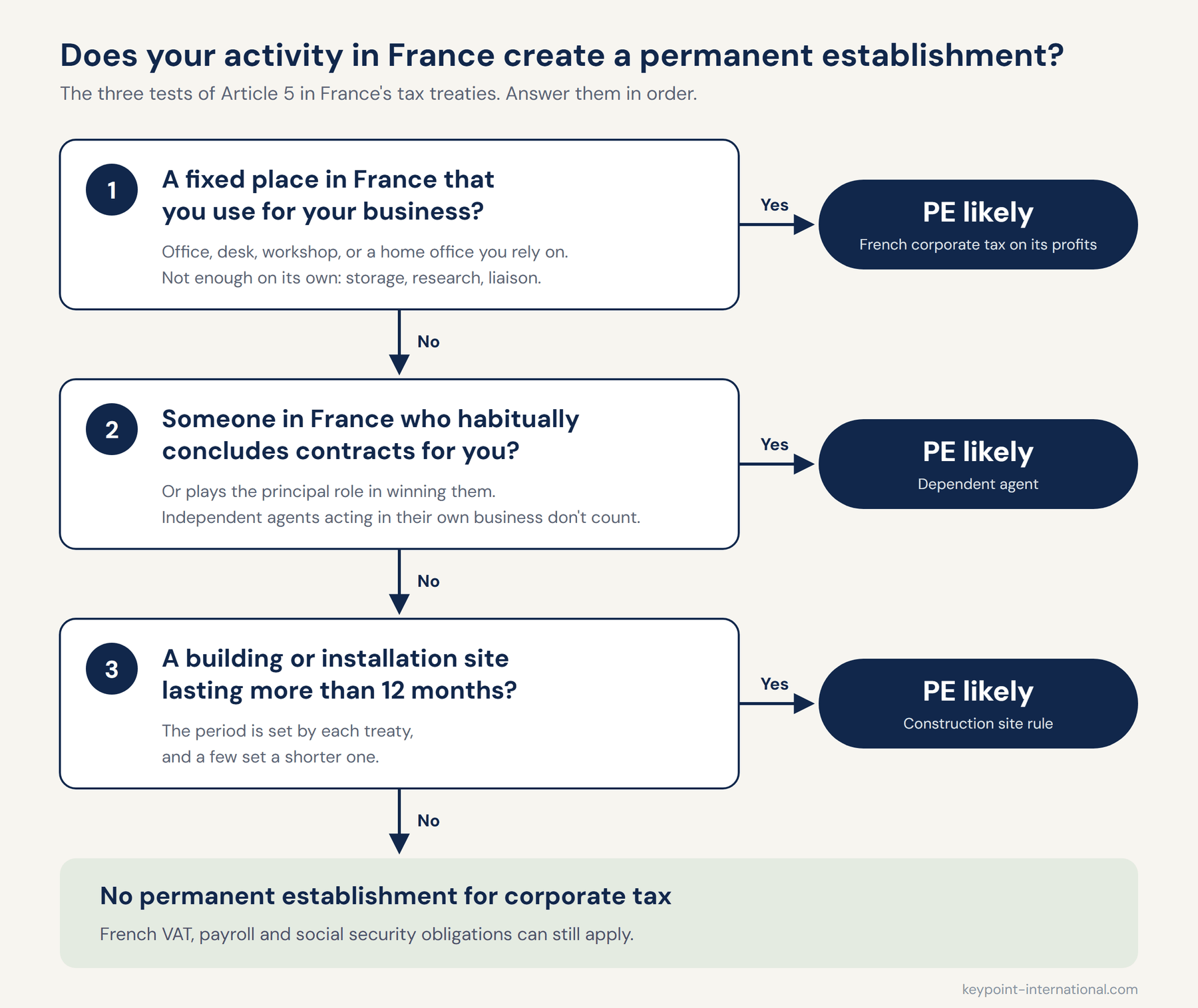
1. A fixed place of business
An office, a branch, a workshop, a co-working desk: any of these counts if it is at your disposal and you run part of your business through it with some permanence. Storage, market research and liaison work are carved out as preparatory or auxiliary, but only while they stay minor relative to the business as a whole. Splitting one operation across several sites to stay under the line does not work.
2. A dependent agent
Someone in France who habitually concludes contracts in your name creates a permanent establishment, office or no office. Under the 2017 OECD wording, now written into many of France's treaties, it is enough that they play the principal role in landing contracts that head office then signs unchanged. Independent agents, such as distributors or brokers acting in their own business, fall outside.
3. A building or installation site
A construction, assembly or installation project turns into a permanent establishment once it runs past the period set in the treaty. Twelve months is the usual figure. Some treaties set less, so read yours rather than assuming.
Can one employee create a permanent establishment?
Yes. Headcount has nothing to do with it; the question is what the person does. A sales manager who negotiates terms and closes deals in France is the textbook dependent agent. Someone running market research, or feeding leads to a sales team abroad, generally is not.
Hiring is where this catches people. France lets a foreign company employ staff without any French entity, by registering with URSSAF as a foreign employer (our guide: hiring in France without a legal entity).
That registration settles social security. It says nothing about corporate tax, and it will not stop your French employee from creating a permanent establishment.
Does remote work create one?
It can, because a home office may qualify as a fixed place of business. The OECD's 2025 update to the Model Tax Convention offers a working threshold: below 50% of working time from a French home over any twelve months, the home office is generally not the employer's place of business. Above it, the question becomes whether there is a commercial reason for the work to happen in France, such as serving French clients, rather than the employee's own preference.
Treat this as a benchmark rather than a safe harbour. It guides how treaties are read; it is not French law, and the tax office is not bound by it. Senior people raise a separate issue, because an executive who makes the company's decisions from France can create a permanent establishment through a place of management.
What about SaaS and digital businesses?
Selling software or digital services into France from abroad, with no people and no premises there, does not create a permanent establishment under the treaty rules as they stand. A website is not a place of business. A server can be, in narrow cases, if you own it, run it, and it does more than deliver pages. France's digital services tax exists but only reaches very large groups.
VAT runs on its own track. It has a separate test, the fixed establishment, and selling digital services to French consumers triggers French VAT whether or not you have a permanent establishment.
PE risk at a glance
| Situation | PE risk | Why |
|---|---|---|
| Salesperson in France who negotiates and signs contracts | High | Dependent agent |
| French office or co-working desk used day to day | High | Fixed place of business |
| Executive taking key decisions from a French home | High | Place of management |
| Construction or installation project over 12 months | High | Site rule in the treaty |
| Employee working from home in France over half the time, serving French clients | Medium to high | Commercial reason to be in France |
| Warehouse used only to store and deliver goods | Low to medium | Auxiliary, unless delivery is your core business |
| Employee doing market research or liaison only | Low | Preparatory or auxiliary |
| Independent distributor or agent | Low | Acts in its own business |
| Selling SaaS online from abroad, no staff or premises | Low | No fixed place, no agent (VAT still applies) |
What happens once one exists?
Profits attributable to the establishment are taxed in France at 25%, and a set of French obligations comes with them:
- Declare it. Where there are premises, that usually means registering a branch at the commercial registry.
- Keep French accounts for the establishment and file an annual corporate tax return.
- Run VAT, the local business tax (CFE) and payroll through it.
- Check the treaty for withholding tax on branch profits. EU parents are exempt; others may not be.
What if the tax office gets there first?
It reconstructs the profits. The standard reach is three years. It stretches to ten where the activity counts as hidden (activité occulte), meaning no returns were filed and the business was never registered (article L169 LPF). Penalties sit on top of the tax: 40% where returns are still missing after formal notice, 80% for a hidden activity (article 1728 CGI), plus interest at 0.20% a month (article 1727 CGI).
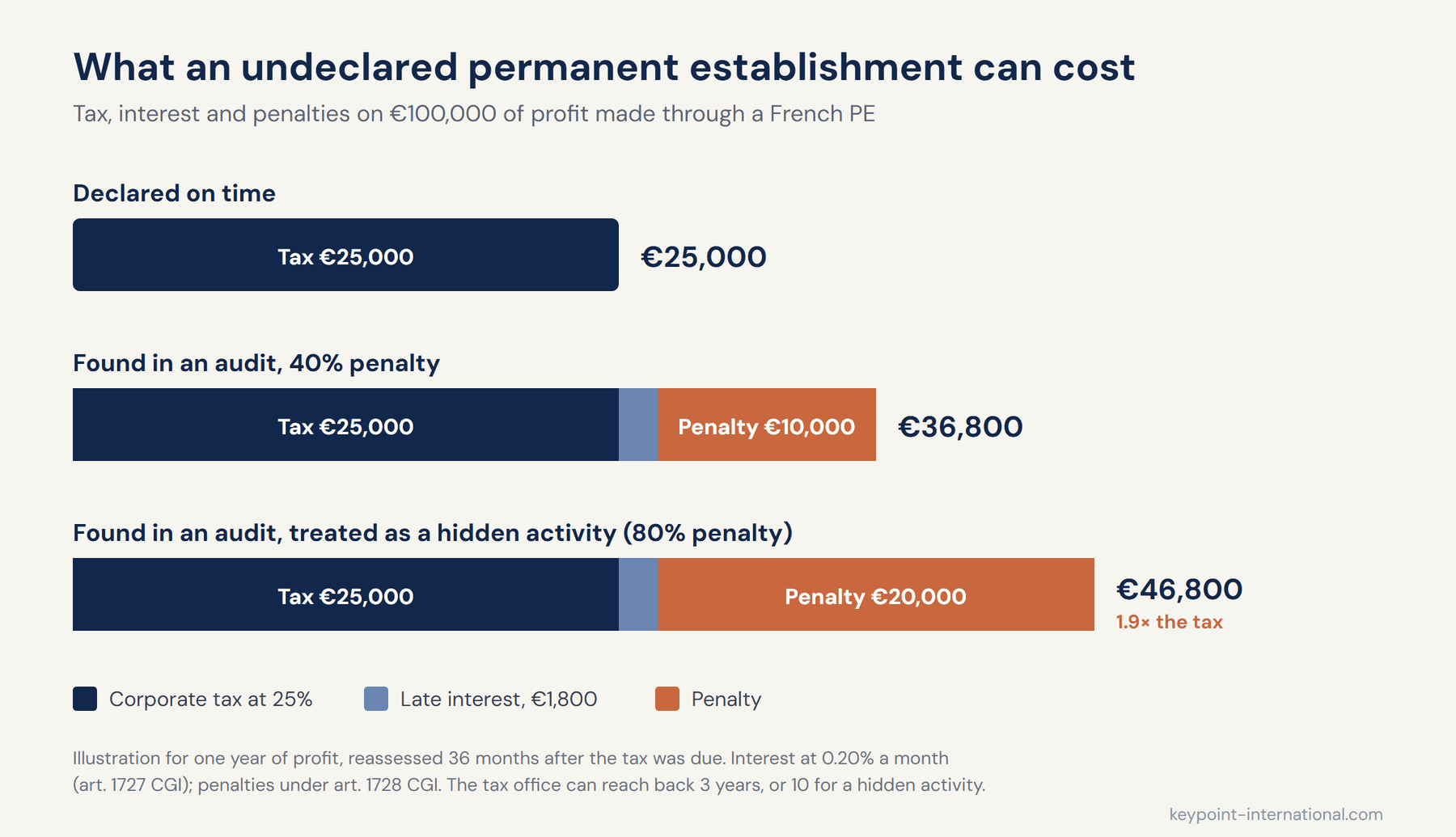
Then a second bill arrives from the other direction. Your home country has already taxed those profits. Recovering that tax means opening a mutual agreement procedure under the treaty, which routinely takes years.
Keeping it under control
- Map what actually happens in France. Who negotiates, who signs, where decisions get made. Job titles tell you little.
- Keep contract authority where you intend it to sit, in practice and not only on paper.
- Track where remote staff work across a rolling twelve months, so the 50% figure is measured rather than assumed.
- Read your treaty. Site periods and agent wording vary from one to the next.
- If a permanent establishment is likely, declare it. A registered branch or a French subsidiary is taxed normally. An undeclared establishment is taxed with penalties on top.
Keypoint International reviews permanent establishment exposure for foreign companies as part of its tax compliance work, and sets up the branch or French subsidiary when the answer is yes.
Sources
- Article 209 CGI: territoriality of corporate tax
- BOFiP, BOI-IS-CHAMP-60-10-10: establishment, dependent representative and complete commercial cycle
- Article L169 LPF: reassessment periods
- Articles 1727 and 1728 CGI: late interest and penalties
- OECD, The 2025 Update to the OECD Model Tax Convention: home office guidance
Key takeaways
- A permanent establishment is a tax status, not a legal entity: you can have one without registering anything in France
- One employee is enough if they negotiate and win contracts; headcount has nothing to do with it
- Where activity was never declared, the tax office can reach back ten years, with penalties of up to 80% on top
Frequently asked questions
What is a permanent establishment in France?
It is the point at which France decides your activity there is substantial enough to tax. French law taxes a foreign company on any business it operates in France (article 209 CGI), and a tax treaty usually narrows that. It is a tax status, not a legal entity, so you can have one without registering anything.
Can a single employee create a permanent establishment?
Yes. Headcount has nothing to do with it; what matters is what the person does. A sales manager who negotiates terms and closes deals in France is the textbook dependent agent. Someone running market research, or feeding leads to a sales team abroad, generally is not.
Does remote work from France create a permanent establishment?
It can, because a home office may qualify as a fixed place of business. The OECD’s 2025 update offers a working threshold: below 50% of working time from a French home over twelve months, the home office is generally not the employer’s place of business. Treat that as a benchmark, not a safe harbour.
Does selling SaaS into France create a permanent establishment?
Not under the treaty rules as they stand, where you have no people and no premises in France. A website is not a place of business. VAT runs on its own track, though: selling digital services to French consumers triggers French VAT whether or not a permanent establishment exists.
What happens once a permanent establishment exists?
Profits attributable to it are taxed in France at 25%, and French obligations follow: declaring it, usually by registering a branch, keeping French accounts, filing an annual corporate tax return, and running VAT, the local business tax and payroll through it. Check the treaty for withholding tax on branch profits.
What are the penalties if the tax office finds an undeclared establishment?
It reconstructs the profits. The standard reach is three years, stretching to ten where the activity counts as hidden. Penalties sit on top: 40% where returns are still missing after a formal notice, 80% for a hidden activity, plus interest at 0.20% a month. Your home country has usually taxed the same profits already.

About the author
David Jian
Partner · Chartered Accountant
David Jian is a partner at Keypoint International, a chartered accountant and Canadian CPA. He advises international groups on setting up and running their operations in France, drawing on senior roles at PwC and Deloitte and management experience across Asia, the Americas and Europe.
A question? A project? Let's talk!
Our team supports you at every step of your establishment and growth in France. Let's discuss your needs.

Benjamin Chemoul & David Jian
Partners & Certified Public Accountants