- News
- ·
Nov 13, 2026
- ·
Reviewed On Nov 13, 2026
How to Read a French Payslip (Bulletin de Paie): A Line-by-Line Guide (2026 + 2027 Outlook)
A French payslip runs to about forty lines and three of them are called net. What each block means, which figure is take-home pay, where your own cost appears, and what changes in 2026 and 2027.

David Jian
Partner · Chartered Accountant

In short
A French payslip must show the items listed in article R3243-1 of the Labour Code, so every payslip has the same shape: an identification block, a contribution table grouped by risk, and the payment figures at the foot. Three different figures on it are called net. Net social is gross less the employee’s compulsory contributions, standardised for benefits purposes. Net payable before income tax is what remains after contributions. Net payable after income tax is what reaches the bank account, because France withholds income tax at source at a rate set by the tax authority. Two further lines show the total reliefs applied and the total the employer paid, so the employee can see the cost of their own employment. Payslips may be issued electronically unless the employee objects, and the employer must keep a copy for five years.
A French payslip, the bulletin de paie, runs to roughly forty lines, most of them acronyms, and the figure the employee cares about sits near the bottom of it.
Almost nothing on the payslip is discretionary, though. Article R3243-1 of the Labour Code sets out, item by item, what the payslip has to show, and the version in force since 1 January 2024 is the one every French-standard payroll software produces. The order is fixed, which means it only has to be learned once. Read the document in that order and the forty lines resolve into three blocks and a handful of informative figures you will use every month.
Every line, and what it means
The top of the payslip identifies the employer and the employee. The middle is the contribution table. The bottom holds the payment figures, and those are the ones people act on.
Article R3243-1 lists sixteen items the document has to carry, and it lists them in a fixed order. Reading down a payslip, this is what each one is.
| Line on the payslip | What it is | Why it matters to you |
|---|---|---|
| Employer name and address, and the establishment | The legal entity that employs the person, and the site they are attached to | A branch or a second site has to show its own establishment, not only head office |
| Activity code and registration number (APE/NAF, SIRET) | The activity classification of the employing establishment, and its number in the national register | Ties the payslip to the right entity, and the activity code shapes which branch agreement is presumed to apply |
| Collective agreement (convention collective) | The branch agreement that applies to the employee, or, where none does, a reference to the Labour Code for paid leave and notice | The agreement sets minimum pay, leave and notice above the statutory floor |
| Employee name, job and classification | The job held and the position in the agreement’s grid, given as a level or a coefficient | The level drives minimum pay and the notice period, so an error here repeats every month |
| Period and hours worked | The pay period and the hours it covers, separating normal hours from those paid at a higher rate and giving the rates applied; for fixed-hour or fixed-day arrangements, the nature and size of the forfait | Lets the employee check the arithmetic, and it is the first place to look when a net figure looks wrong |
| Salary accessories (accessoires de salaire) | Bonuses, commission, overtime and benefits in kind, where they are subject to contributions | Leaving a benefit in kind out understates the base for every contribution below it |
| Gross pay (rémunération brute) | Base salary plus those accessories, before any contribution is taken | The figure the contract quotes, and the base the whole table is built on |
| Contributions, with their base (cotisations et contributions) | For each contribution: the base, the employer amount and the employee amount, shown before the reliefs below, with the employee rates | The employee column comes out of gross pay; the employer column is a cost on top of it |
| Other deductions and payments | Anything withheld or paid that is not a social contribution, such as the employer’s share of a transport season ticket | Explains differences between the contribution table and the sum actually paid |
| Income tax withheld at source (prélèvement à la source) | The base, the rate and the amount withheld, and the sum the employee would have received without the withholding | That last sum is the net payable before income tax, and the rate belongs to the tax authority, not to you |
| Net social (montant net social) | Gross pay including benefits in kind, less the employee’s compulsory contributions, as defined in article R844-1 of the Social Security Code | One standard figure that benefits offices read across all employers |
| Amount actually received (net à payer après impôt) | The sum transferred to the employee | What reaches the bank account, and the only figure that does |
| Date of payment | The date the sum is paid | The pay date, which is not the same as the end of the pay period |
| Leave dates and holiday pay | Where a period of annual leave falls inside the pay period, the dates and the amount paid for it | Shows holiday pay has been paid, which employees query often |
| Total reliefs and exemptions | The total of the contribution reliefs and exemptions applied to the gross pay | Since 1 January 2026 this is the single degressive general reduction |
| Total paid by the employer | Gross pay plus employer contributions, less those reliefs | Your monthly cost for that employee, printed where the employee can read it |
| Link to the official payslip page | A reference to the payslip section of the service-public.fr portal | Mandatory on every payslip issued since 1 January 2024 |
| Short-time working (activité partielle), where it applies | The hours compensated, the rate used to calculate the allowance, and the sums paid | Appears only in months where short-time working was used |
The top block carries the employer’s name and address, the activity code, the collective agreement that applies to your employee (convention collective), and the employee’s job title and classification. The job title and the classification deserve a slow read with your adviser when the contract is drawn up. The classification level drives the minimum pay and the notice period your agreement imposes, so an error there repeats in every payslip until someone catches it.
Gross pay, and what counts as gross
Gross pay (salaire brut) is the base salary plus anything that behaves like salary: overtime paid at the uplifted rate that applies to it, bonuses, commission, and benefits in kind. The payslip also shows the hours the pay relates to, separating normal hours from those paid at a higher rate, so the employee can check the arithmetic without coming to you for a breakdown.
Benefits in kind form part of gross pay even though no money changes hands. A company car the employee may use privately, or accommodation provided by the company, counts as salary once contributions are worked out, so each benefit is given a value and added into the gross figure. Leave one out and the gross figure is too low, which in turn makes the base too low for every contribution in the table that follows. That is one of the more common findings in a payroll inspection.
The contribution table
The contribution table is one row per contribution, grouped by what the contribution pays for: health, workplace accidents, retirement, family, unemployment, and then the social levies CSG and CRDS. Each row shows the base it is calculated on, the employee rate and amount, and the employer rate and amount.
Each row carries an employee column and an employer column, and the two behave differently. The employee column is taken out of the gross figure, and it explains the gap between the salary written into the contract and the sum that reaches the bank account. The employer column never touches the employee’s pay; it is a cost carried on top, so the salary you negotiate is only part of what you budget. Employee contributions come to roughly 20.8% of gross across the table, and that share barely moves with salary, so a senior hire gives up about the same proportion as a junior one. The guide to what an employee costs sets out the employer side in figures.
To note: the relief line changed this year. On 1 January 2026 the general relief became the single degressive general reduction (réduction générale dégressive unique), so the line that used to show several reductions now shows one. That reduction is worked out on the full employer rates, 13% for sickness and 5.25% for family allowances, and Urssaf states that it cannot be combined with the separate reduced rates for those two contributions on the same employee. A 2025 payslip and a 2026 payslip for the same person therefore no longer line up row for row, which is worth going through with your adviser before you compare them. Urssaf publishes the current rates.
The three figures called "net"
Three numbers on the payslip all look like take-home pay, which is where foreign employers and their employees most often talk past each other. Each one answers a different question.
| Line on the payslip | What it is | What it is used for |
|---|---|---|
| Net social (montant net social) | Gross, including benefits in kind, less the employee’s compulsory contributions | A standard figure benefits offices read across all employers |
| Net payable before income tax (net à payer avant impôt) | What is left once contributions are taken off, before withholding | Comparing offers, and checking the contribution table |
| Net payable after income tax (net à payer après impôt sur le revenu) | The amount transferred to the bank account | What the employee actually receives that month |
- Net social (montant net social). Gross, including benefits in kind, less the employee’s compulsory contributions. It exists so benefits offices can read one standard figure, and it is defined in article R844-1 of the Social Security Code.
- Net payable before income tax (net à payer avant impôt). What the employee has earned once contributions are taken off, before the tax authority takes its share.
- Net payable after income tax (net à payer après impôt sur le revenu). The amount that reaches the bank account.
Income tax is withheld at source in France, which puts one more rate on the payslip. That withholding rate (taux de prélèvement à la source) applies to income tax alone and has nothing to do with the contribution rates in the table above, so the payslip shows it separately, with the base it is applied to, the amount withheld, and alongside them the sum the employee would have received without the withholding. The withholding rate comes from the tax authority, not from you, which is worth saying plainly to an employee who assumes their employer chose it.
What it costs you, on the same page
Near the foot of the payslip sit two lines that your finance team will ask for. The first gives the total of the reliefs and exemptions applied to the pay. The second gives the total the employer paid out that month: gross pay plus employer contributions, less those reliefs.
The total paid by the employer is the monthly cost of that employee. It is printed on the employee’s own payslip, where the employee can read it, and employees do read it, so have the figure in mind before you open a salary review.
A worked example
Take a salary of €2,500 gross a month, outside Paris, in a small company with no works council. Employee contributions take about €521, so the net before income tax is roughly €1,979. The employer pays about €616 on top after relief, which puts the monthly cost of that employee at about €3,116. Those are the three figures to carry into a budget.
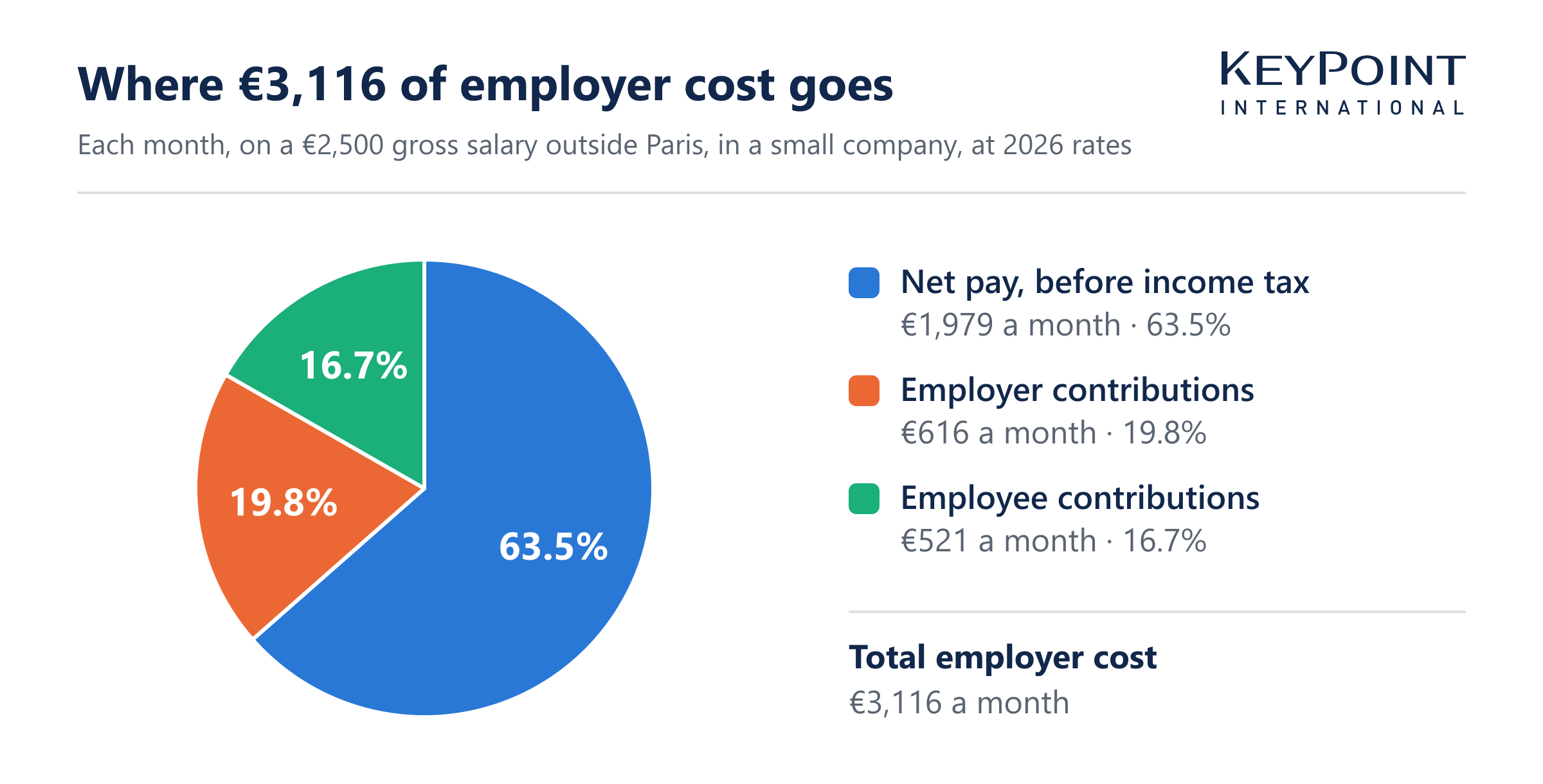
The employer’s share rises with salary, because the relief tapers out as pay increases. At €4,000 gross the employer rate is around 37.9%, against 24.6% at €2,500, and the taper accounts for the whole difference. A raise therefore adds more to the company’s cost than it adds to the gross salary, which is the part that catches out a head office working from gross figures alone. Price a raise on the employer cost with your adviser before you commit to it.
Keeping them, and who can see them
Since 2017 the payslip can be issued electronically by default, and your employee has to object if they want paper (article L3243-2). Where it is electronic it has to stay available to them, which is why most payroll providers post it to a personal vault rather than email it.
You must keep a copy for five years (article L3243-4). Your employee should keep theirs for good, because it is the proof behind a pension claim decades later. Note that getting the payslip rules wrong is a third-class fine, charged per payslip, so the exposure grows with every month the error has been running.
What to watch in 2027
The 2027 social security bill carries one measure that matters for payroll, and it lands on the relief line. The proposal would change how salary supplements count towards the pay used to calculate the relief coefficient, without altering the formula or the three-times-minimum-wage ceiling. If it passes, the relief line changes and the rest of the table stays as it is.
However, none of that is law yet. The National Assembly rejected the text on 23 October 2026 and it went to the Senate on 2 November, where it is in committee. Budget on the 2026 scale, and treat anything drawn from the bill as a draft.
Where this leaves you
Read the payslip from the bottom up when you are checking it: the amount paid, the three nets, then the total cost. Read it from the top down when something looks wrong, because errors usually start in the classification or the hours before they reach the arithmetic. The French document will not change language, so if your adviser runs the payroll, ask them to give you the figure your head office needs in the format it uses.
If you would like to inquire about your case in France to local experts, feel free to contact KeyPoint International - we are supporting foreign businesses in France in their incorporation and success since 2003.
Sources
- Code du travail, article R3243-1 - the mandatory items on a payslip, in force since 1 January 2024
- Code du travail, article L3243-2 - electronic payslips and the employee's right to object
- Code du travail, article L3243-4 - the employer's five-year retention obligation
- Code du travail, article R3246-2 - third-class fine for breaching the payslip rules
- Code de la sécurité sociale, article R844-1 - the definition behind the net social figure
- Urssaf, private sector contribution rates - current employee and employer rates
- Urssaf, the single degressive general reduction - what the reduction covers, and that it cannot be combined with the reduced sickness and family rates
- Sénat, PLFSS 2027 dossier - rejected by the Assembly on 23 October 2026, transmitted to the Senate on 2 November
Key takeaways
- Almost nothing on a French payslip is optional: article R3243-1 fixes the items it must show, so every payslip has the same shape
- Three different figures are called net - net social, net before income tax, and net after income tax - and only the last is what reaches the bank account
- The employer’s total monthly cost is printed on the employee’s own payslip, and you must keep a copy for five years
Frequently asked questions
What is the montant net social on a French payslip?
Montant net social is gross pay, including benefits in kind, less the employee’s compulsory social contributions. It was standardised so that benefits offices read one consistent figure across all employers, and it is defined in article R844-1 of the Social Security Code. It is not the amount paid into the bank account.
Why are there three different net figures?
Each one answers a different question. Net social is a standardised figure for benefits purposes. Net payable before income tax is what remains after contributions. Net payable after income tax is the amount actually transferred, because France withholds income tax at source. The payslip must show all three.
Who sets the income tax rate shown on the payslip?
The tax authority sets it, and the employer simply applies it. The payslip must show the base, the rate and the amount withheld, and also the sum the employee would have received without the withholding. An employee who disputes the rate takes it up with the tax office through their own online account.
How long must a French employer keep payslips?
Five years, under article L3243-4 of the Labour Code, whether the payslip was issued on paper or electronically. Employees are usually advised to keep theirs indefinitely, because payslips are the supporting evidence for a pension claim decades later.
Can a French payslip be issued electronically?
Yes, and since 2017 that is the default. The employer may issue it electronically unless the employee objects, provided the document stays available and confidential. This is why payroll providers typically deposit payslips in a personal digital vault rather than sending them by email.
Does the payslip show what the employee costs the company?
Yes. One line gives the total reliefs and exemptions applied, and another gives the total paid by the employer, meaning gross plus employer contributions less those reliefs. Both are mandatory, so the employee can see the full cost of their own employment.

About the author
David Jian
Partner · Chartered Accountant
David Jian is a partner at Keypoint International, a chartered accountant and Canadian CPA. He advises international groups on setting up and running their operations in France, drawing on senior roles at PwC and Deloitte and management experience across Asia, the Americas and Europe.
A question? A project? Let's talk!
Our team supports you at every step of your establishment and growth in France. Let's discuss your needs.

Benjamin Chemoul & David Jian
Partners & Certified Public Accountants