- News
- ·
Oct 12, 2026
- ·
Reviewed On Oct 30, 2026
English-Speaking Accountant in France: How to Choose and What to Know
Every French firm says it speaks English. Two things decide whether it works, and neither is on the website. What to check on the Ordre register, what belongs in the engagement letter, and why your accounts stay in French whoever you hire.

David Jian
Partner · Chartered Accountant

In short
A French accountant cannot file in English. Article L123-22 of the Commercial Code requires accounting documents to be drawn up in euros and in French, and the data file handed over in a tax audit follows the French chart of accounts. An English-speaking accountant therefore sells you understanding rather than translation of the filings themselves. Check the firm on the Ordre des experts-comptables register first, since the title is regulated. Then test whether English is a process there or one bilingual partner, by asking for a sample reporting pack and the name of the person who will own your file. Put every English deliverable in the engagement letter, because scope and fees are fixed there. The gap costs money in three places: a formal notice running its deadline unread, group consolidation mapping, and a tax audit.
Every French firm with a foreign-client practice says it speaks English. The claim costs nothing to make and tells you very little. Two things decide whether the arrangement works, and neither appears on the website: whether the firm is registered to keep your books at all, and whether English is a process there or one helpful person who happens to answer the phone.
French law also requires your accounting records to be kept in French, which rarely comes up in a first meeting. What you are buying is someone who makes sure you understand that paperwork before a deadline runs out.
The first check is the one in the register
The title of chartered accountant (expert-comptable) is regulated. Ordonnance n° 45-2138 of 19 September 1945 defines the profession as making a habitual business of keeping, centralising, closing, monitoring, correcting and consolidating the accounts of businesses the professional is not employed by. That is the work you are buying, and the person doing it should be on the roll of the Ordre des experts-comptables.
You can check this yourself in about a minute. The public register is free and searchable by name, firm and town, and a registered professional will give you their registration number without being asked twice. If someone offering to keep your books is not on the register, that is where the conversation stops, whatever the quote says.
What the register will not tell you is whether the firm has handled a company like yours, or whether anyone there works in English. That is what the first call is for.
"English-speaking" is a process, not a person
Ask a French firm whether they speak English and the answer is always yes. The question that separates them is narrower: who will own our file day to day, and in which language will that person work?
It matters because the people differ. The partner in the pitch meeting is usually fluent. The person who sends the VAT reminder in March often is not. A firm with truly an English-language practice has English reporting templates, English engagement letters, and more than one person who can answer a payroll question without routing it through a colleague or Copilot.
Two things to ask for:
- The name and job title of the person who will handle your file
- What happens to your questions when that person is away
The engagement letter is where the deal sits
French firms work under an engagement letter (lettre de mission) that sets out scope, deliverables and fees. It is a professional requirement, and it is the document that decides what you are buying.
Read it for what is missing. Statutory accounts and the corporate tax return are almost always in. Group reporting packs, a bridge to IFRS or US GAAP, VAT registration, payroll, and answering your parent company’s auditor are often not, and each of those generates an invoice you did not plan for. If you need reporting in English, it belongs in the letter as a deliverable, not as a shared understanding.
Fees are usually a fixed annual or monthly amount for a defined scope, with hourly rates beyond it. Compare firms on what the fixed fee covers rather than on the number itself.
Five questions for the first call
- What is your registration number, and which regional Ordre are you on?
- Who opens a letter from the tax office or Urssaf, and how soon do I hear about it?
- Can you produce a bridge from the French accounts to our group’s reporting standard?
- What is inside the fixed fee, and what is billed on top?
- Who covers our file when our contact is away?
What the law requires in French
Article L123-22 of the Commercial Code (Code de commerce) is a single sentence: accounting documents are drawn up in euros and in the French language. The same article requires them to be kept for ten years.
That is not a preference, and no firm can contract around it. Your ledger, your journals and your statutory accounts are French-language documents. So is the corporate tax return (liasse fiscale), the VAT return, the payroll declaration (déclaration sociale nominative, or DSN), and anything filed at the commercial court registry (greffe).
It reaches further than the documents you read. If the tax authority audits you, you hand over an accounting entries file (fichier des écritures comptables, or FEC). Article A47 A-1 of the Tax Procedures Code fixes its format: eighteen mandatory fields in a set order, account numbers whose first three characters follow the French chart of accounts (plan comptable général), account labels following the same nomenclature, and a filename in the form SirenFECAAAAMMJJ. Even the data file an inspector receives is structurally French.
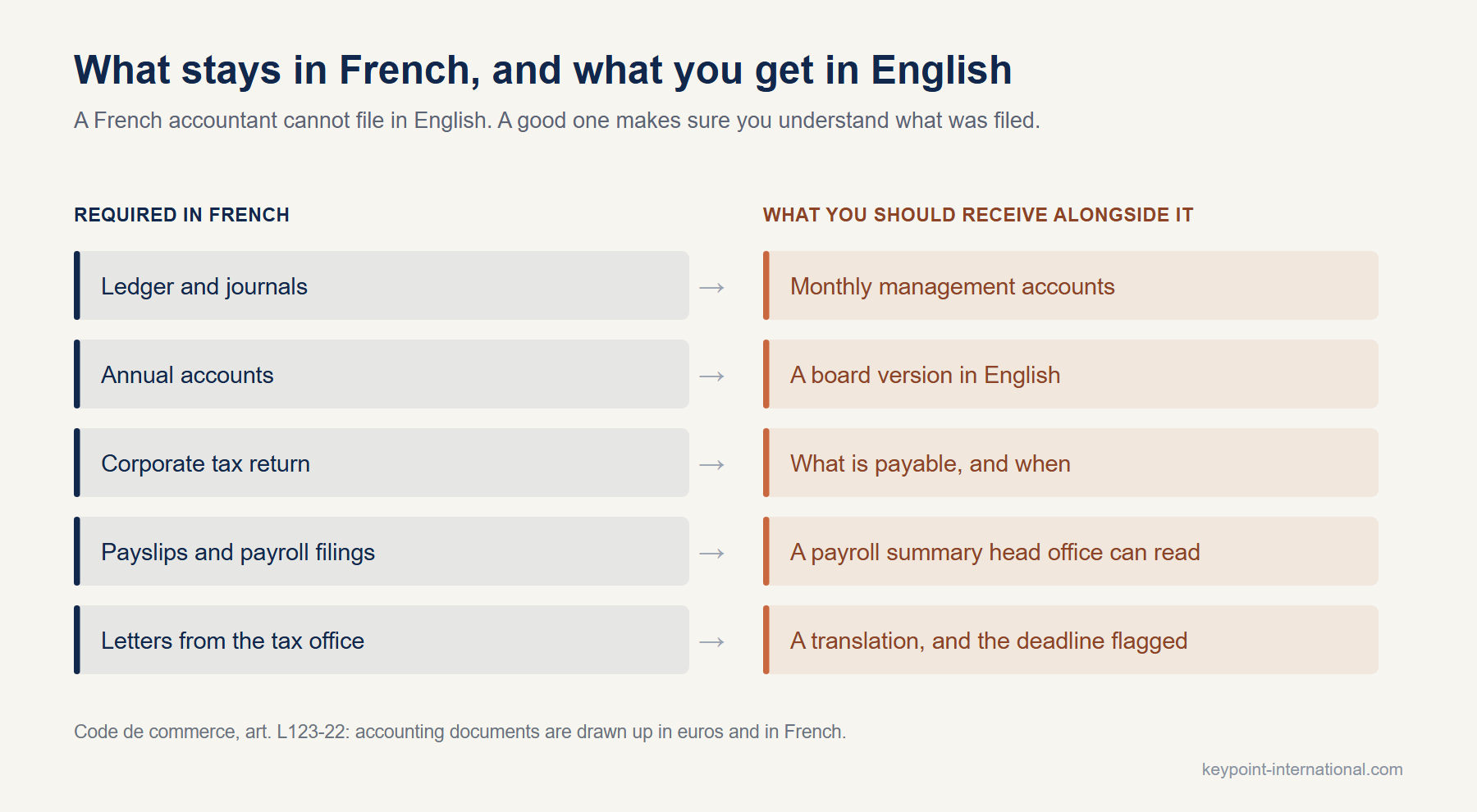
What you should get alongside each document
| Document | Required language | What you should receive alongside it |
|---|---|---|
| Ledger and journals (livres comptables) | French, in euros | Monthly management accounts in English from the same ledger |
| Annual accounts (comptes annuels) | French | An English version for your board, marked as a translation |
| Corporate tax return (liasse fiscale) | French | A short English note on what is payable and when |
| VAT return (CA3) | French | An English VAT summary with the payment date |
| Payroll filings (DSN) and payslips | French | A payroll summary head office can read |
| Audit data file (FEC) | French chart of accounts, fixed format | An explanation of what was handed over |
| Letters from the tax office or Urssaf | Arrive in French | A translation, and the deadline flagged |
| Filings at the commercial court registry (greffe) | French | Confirmation of what was filed, and when |
| Engagement letter (lettre de mission) | May be bilingual | A version signed in a language you read |
Three places the language gap costs money
A letter with a clock attached: tax and social security correspondence arrives in French, on paper, at your registered office. A formal notice (mise en demeure) starts a deadline running whether or not anyone in your organisation opened it. If that address is a domiciliation service and nobody there is reading the post in French, the first you hear of a problem can be a recovery notice with penalties already on it. This is the most expensive version of the language gap, and it begins with unopened post. It is also the best argument for taking your registered office at your accountant’s own address: the people opening the letter are then the people who can read it, act on it and tell you what it means.
Consolidation: French statutory accounts follow the French chart of accounts. Your group reports under IFRS, US GAAP or a national standard of its own. Somebody has to map one to the other. If your French accountant does not, your group finance team ends up doing it from documents they cannot read. Settle who owns that mapping before the first year-end rather than during it.
A tax audit: the questions arrive in French, the FEC goes over in the French chart of accounts, and your answers have to match accounts head office has never seen in the original. One firm that can explain the file in both directions keeps that as one conversation.
Where this leaves you
Check the register, then test the process, then put the English deliverables in the engagement letter. The language question matters, though not for the reason most people assume. Nothing you file changes language, so what you are buying is someone who closes the gap between what the French administration says and what your board understands.
Keypoint International works with foreign-owned companies in France, which means English is the working language with head office and French is the working language with the administration. Accounting and financial statements, tax compliance, payroll and the legal filings sit with one team, so the French document and the English explanation come from the same place.
If you are earlier in the process, how to choose an accountant in France covers the selection itself in more detail, what to look for in a firm compares the options, and setting up in France comes before either. If you are budgeting a first hire, what an employee costs has the figures.
Key takeaways
- Article L123-22 of the Commercial Code requires accounting documents to be drawn up in euros and in French, and no firm can contract around it
- "English-speaking" should mean a process: English templates, English engagement letters, and more than one person who can answer without routing it onward
- If you need reporting in English, it belongs in the engagement letter as a deliverable rather than as a shared understanding
Frequently asked questions
Do French accounts have to be kept in French?
Yes. Article L123-22 of the Commercial Code is a single sentence: accounting documents are drawn up in euros and in the French language, and kept for ten years. That covers your ledger, journals, statutory accounts, the corporate tax return, the VAT return and the payroll declaration.
How do I check a French accountant is properly registered?
Ordonnance n° 45-2138 of 19 September 1945 defines the profession, and the person keeping your books should be on the roll of the Ordre des experts-comptables. The public register is free and searchable by name, firm and town, and takes about a minute to check.
What does "English-speaking" actually mean in practice?
Ask a French firm whether they speak English and the answer is always yes. The narrower question is who owns your file day to day, and in which language that person works. The partner in the pitch meeting is usually fluent; the person sending the VAT reminder in March often is not.
What should the engagement letter cover?
Read it for what is missing. Statutory accounts and the corporate tax return are almost always in. Group reporting packs, a bridge to IFRS or US GAAP, VAT registration, payroll and answering your parent’s auditor are often not, and each generates an invoice you did not plan for.
Where does the language gap actually cost money?
Three places. French tax and social security post arrives at your registered office with deadlines already running. Consolidation needs somebody to map the French chart of accounts to your group standard. And in an audit the entries file (FEC) goes over in French, in a format fixed by article A47 A-1.

About the author
David Jian
Partner · Chartered Accountant
David Jian is a partner at Keypoint International, a chartered accountant and Canadian CPA. He advises international groups on setting up and running their operations in France, drawing on senior roles at PwC and Deloitte and management experience across Asia, the Americas and Europe.
A question? A project? Let's talk!
Our team supports you at every step of your establishment and growth in France. Let's discuss your needs.

Benjamin Chemoul & David Jian
Partners & Certified Public Accountants