- News
- ·
Oct 23, 2026
- ·
Reviewed On Oct 30, 2026
How to Organise Sales in France: Agent, Distributor, Employee or Subsidiary
Agent, distributor, employee or subsidiary. Five ways to sell into France, what each one does to your tax position, and the termination indemnity French law will not let you contract out of.

David Jian
Partner · Chartered Accountant

In short
A foreign company has five ways to sell into France, and they differ most in what it costs to stop. Exporting is free to unwind until you hold stock in France or somebody starts acting for you there. A distributor buys and resells on its own account, so there is no French VAT registration and no taxable presence for you, at the price of losing the customer relationship, and it only works if you make a physical product. A commercial agent sells in your name, and the Commercial Code fixes notice periods you cannot shorten plus a termination indemnity no contrary clause can exclude, customarily around two years of gross commission. Calling that person a freelancer does not avoid it, because the Cour de cassation holds that agent status depends on how the work is actually carried out rather than on what the contract says. A freelancer who only sells you a service is a service provider, while one who negotiates your deals is an agent. Either can be reclassified as an employee where you direct how they work, which costs backdated contributions and six months of salary. Employing somebody in France without an entity suits support roles, while a salesperson who closes deals is a French tax presence in all but name. A subsidiary or branch is the most committing route and the most predictable.
Before the entity, the accountant and the payroll, there is a question that decides all three: how are you going to sell? Five routes are open to a foreign company in France. They differ less in what they cost to start than in what happens when you want to stop.
A distributor you can simply stop supplying. A commercial agent carries a termination payment that French law will not let you write out of the contract. A freelancer managed like a member of staff can be reclassified as an employee years later, with the contributions recalculated back to the beginning.
The five routes
Here is the summary, and do not worry if it looks like a lot at once. We walk through every option below.
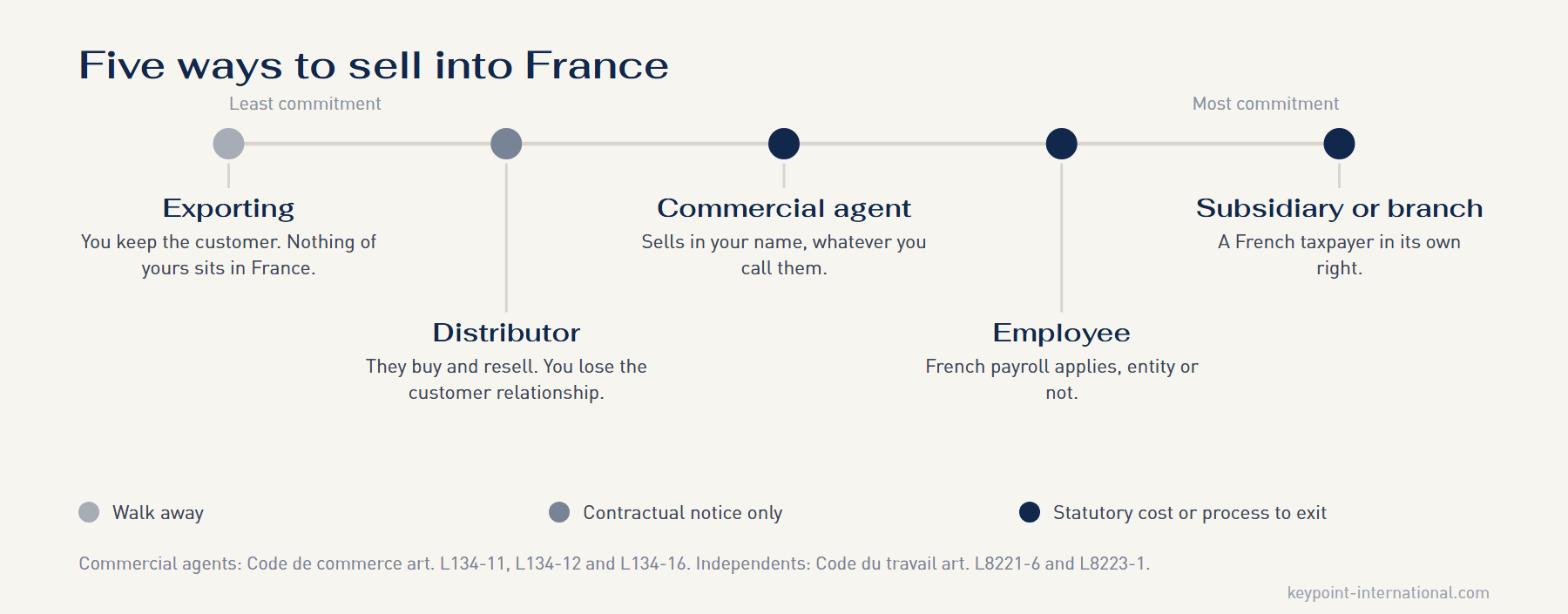
| Route | Who holds the customer | French VAT for you | French tax presence | What it costs to end |
|---|---|---|---|---|
| Sell from abroad (exporting) | You | Only if you hold stock in France | None, while nobody acts for you there | Nothing |
| Distributor | The distributor | No, they invoice the customer | None | The notice in the contract |
| Commercial agent (freelancer) | You | Yes, you invoice the customer | Possible, on the treaty test | Statutory indemnity you cannot exclude |
| Employee | You | Yes | Likely | French dismissal rules |
| Subsidiary or branch | You | Yes | Yes, it is a French taxpayer | Formal closure or liquidation |
Selling from abroad (exporting)
The simplest route, and most companies underestimate how long they can stay on it. You invoice from your own country, ship from your own country, and nothing of yours sits in France. No French entity, no French payroll, no French corporate tax.
Unfortunately, two problems stop you from doing this forever. The first is stock: once you hold goods in France, in your own warehouse or a third party’s, you need a French VAT number whether or not you have an entity. The second is people. As soon as somebody in France acts for you on a regular basis, the question stops being VAT and becomes whether you have a permanent establishment.
A distributor
A distributor buys your product and resells it on its own account. It takes title, carries the credit risk, invoices the French customer in its own name and sets its own resale price within the limits competition law allows.
That is the cleanest risk profile on this list. You do not register for French VAT, because you are selling to a French business rather than to French end customers. You do not create a taxable presence, because the distributor trades for itself rather than for you. Ending the relationship means serving the notice the contract provides.
What you give up is the thing most companies are trying to build. You do not own the customer relationship, you do not see the end-customer data, and you do not control the price your product sells at. For a company whose plan is to enter France now and sell directly later, a distributor can be an expensive way to spend three years. It is also only open to some kinds of business: if you manufacture a physical product there is somebody to buy and resell it, and if you sell software or services there usually is not.
A commercial agent (freelancer)
An agent that sells in your name is the classic way into a new market. They already know the buyers, they work on commission, and you pay nothing until something sells. Many companies try to get the same thing more cheaply by hiring a freelance salesperson who simply invoices them each month. Under French law those are usually the same arrangement.
Article L134-1 of the Commercial Code defines a commercial agent (agent commercial) as an independent professional with a permanent mandate to negotiate, and where applicable conclude, sales on behalf of a principal. Three parts of that carry the weight. The mandate has to be permanent, so a one-off introduction does not count. The agent acts in your name, which is what separates them from a distributor acting in its own. And negotiating is enough by itself, because they never have to sign anything for the status to attach.
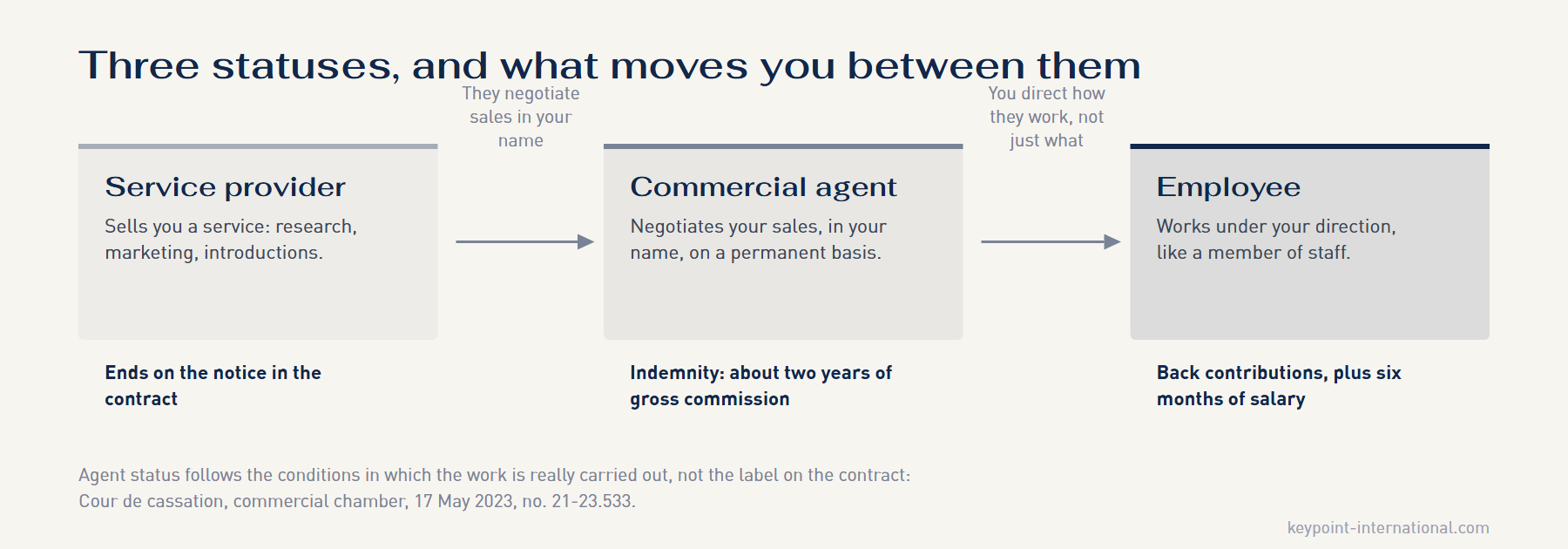
What you call the arrangement does not control it. The commercial chamber of the Cour de cassation said so plainly in May 2023: agent status depends neither on the intention the parties expressed in the contract nor on the name they gave their agreement, but on the conditions in which the activity is actually carried out. In that case the two sides had agreed in writing that the agent statute applied, and the court still sent the file back to be decided on what the person had really been doing. So calling somebody a freelancer does not stop them being an agent, and calling them an agent does not make them one.
However, note that for non-sales roles, the story is different. A freelancer who sells you a service, such as market research, marketing, or introductions where they never discuss terms, is a service provider and none of this applies.
Once the status attaches, two rules follow that your contract cannot displace. Notice is fixed by Article L134-11: one month in the first year, two in the second, three from the third onwards, and you may agree longer periods but never shorter. Compensation is then owed when the relationship ends, under Article L134-12. It is not a penalty, and it does not depend on anyone being at fault. What it repairs is the loss of the client base the agent built up in your name, which is why it is owed even when you part on good terms. The statute names no figure. French judges assess it case by case, and the benchmark they work from is roughly two years of gross commission. The agent must claim it within a year of termination or forfeit it.
Underneath all of that sits a second risk. Article L8221-6 of the Labour Code presumes that somebody registered with the commercial register, the commercial agents register or the social security collection agency (Urssaf) is not your employee. That presumption falls away where the person works in conditions placing them in permanent legal subordination, in French a lien de subordination juridique permanente. Working only for you is the strongest single indicator, and the first thing a social security inspector looks at, but exclusivity on its own is not the legal test. What decides it is whether you direct them the way you direct staff: setting their hours, telling them how to do the work instead of what result you want, requiring them to work through your systems, putting them in a team under a manager.
If the relationship is reclassified, employer contributions are recalculated on everything you paid across the whole period, and Article L8223-1 adds a flat six months of salary when it ends.
For a market you intend to stay in, two years of commission is a fair price for somebody else’s client book. For a market you are only testing, it is a liability building quietly while you make up your mind.
An employee
You can employ somebody in France without a French entity. You register as a foreign employer, the person is covered by French social security, and you pay the same contributions a French company pays, which an earlier article sets out in figures.
For the right role this is a sound and well-used structure. Somebody running market research, supporting customers you already have, handling marketing, or representing you at trade fairs can sit on a foreign payroll in France for years without raising a difficult question, because none of that amounts to selling on your behalf.
A salesperson is a different matter, and this is where the structure usually fails. An employee who negotiates terms and closes deals in France is doing, under your direction, the very thing a tax treaty treats as acting for you in France. You have no office, no entity and no French filings, and you can still have a permanent establishment, because the profit attributable to that person’s work is taxable in France. Having registered nothing is no protection either, since an assessment can reach back over earlier years.
A subsidiary or branch
At some volume this is simply how you run the business. A French subsidiary, almost always a simplified joint-stock company (société par actions simplifiée, or SAS), is a French company in every ordinary sense: it holds its own bank account, employs its own people, files its own accounts and its own corporation tax return, and its liability stops at its own balance sheet. The parent owns the shares and nothing beyond them.
A branch (succursale) is the lighter version of the same idea and the more exposed one. Because it is not a separate legal person, it files and pays tax in France on what it earns there while the parent carries every liability it runs up. Companies often reach for a branch because it opens faster, then find that the time they saved came out of the protection they wanted.
Both routes end the uncertainty. You are taxed in France, which settles the question hanging over every other route on this list. Your own group’s contracts govern the sales relationship, because the seller is your own company. And closing down is a formal procedure whose cost you can work out in advance.
The two tests people confuse
Two different questions get merged constantly.
The first is a commercial law question: is this person a commercial agent? The Commercial Code answers it, and it turns on whether they negotiate in your name on a permanent basis. Get it wrong and you owe an indemnity.
The second is a tax question: do you have a permanent establishment in France? The tax treaty between France and your own country answers it, and it turns on whether somebody habitually concludes contracts for you, or does the real work of winning them while you sign as a formality. Get it wrong and you owe French corporation tax on the profit attributable to that activity, with penalties on top.
Most of the time the two tests point the same way. If somebody in France wins your deals for you, they are probably a commercial agent. Under most modern tax treaties they will usually create a permanent establishment as well, even when you sign the contracts yourself from abroad. Some older treaties are narrower and only count a person who can sign contracts that bind you. So assume that one person triggers both, then check the treaty with your own country to see whether that is too cautious. The permanent establishment article takes the tax test on its own terms.
Where to start
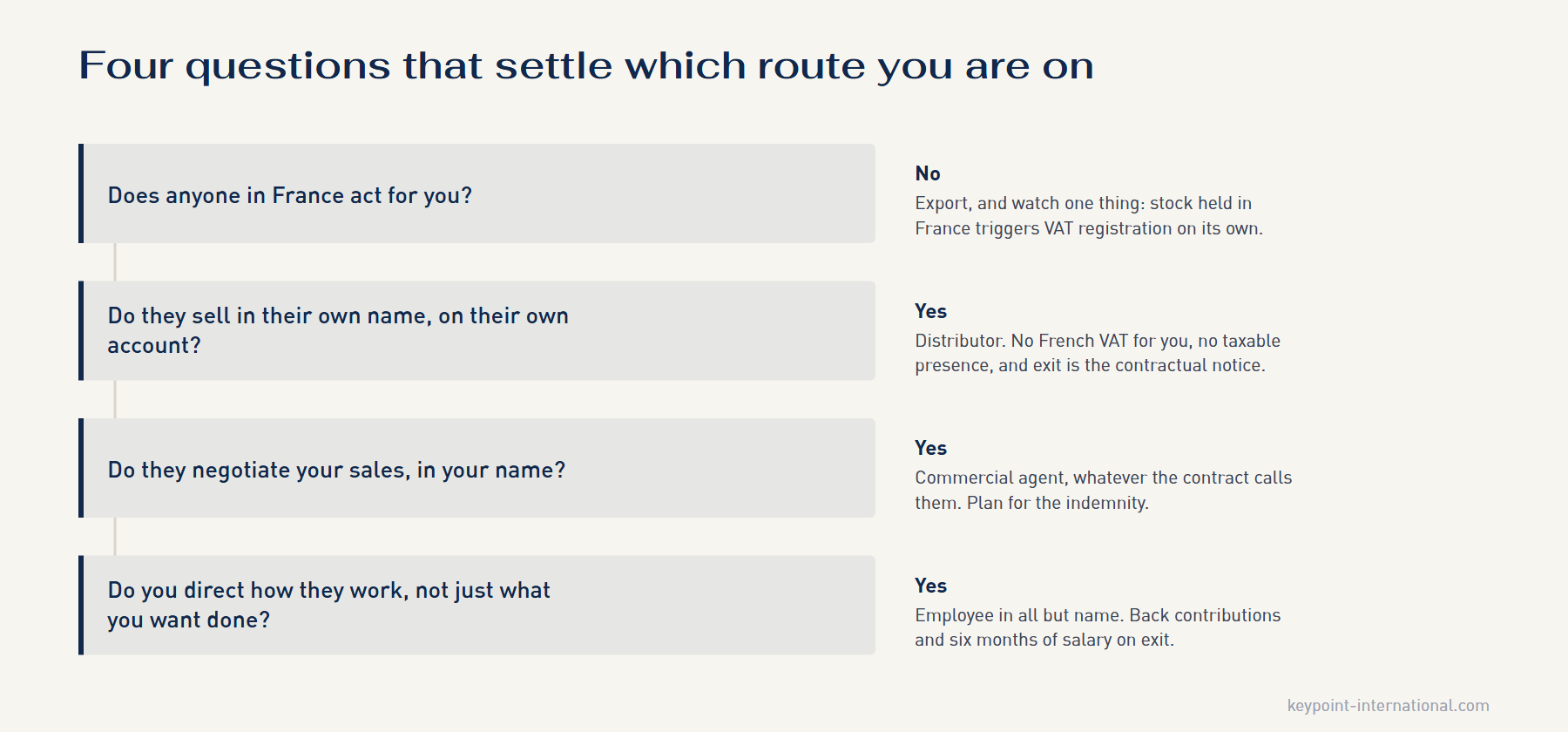
If you are testing the market, export and watch for the two triggers: stock held in France, and anybody acting for you regularly. If you want volume without commitment, a distributor is the cheapest route to unwind. If you want to own the customer, the question is no longer whether to have a French presence but which kind, and that decision belongs before you sign anything.
Keypoint International advises foreign companies on which of these routes fits, and then runs the one they choose: company and branch formation, tax compliance, payroll and the legal work around agency and distribution agreements.
Key takeaways
- The five routes differ less in what they cost to start than in what happens when you want to stop
- A commercial agent is owed end-of-contract compensation that the contract cannot remove, and French judges work from roughly two years of gross commission
- A freelancer managed like a member of staff can be reclassified as an employee, with contributions recalculated back to the beginning
Frequently asked questions
Can a foreign company sell in France without setting up an entity?
Yes, by exporting, by appointing a distributor or a commercial agent, or by employing somebody as a registered foreign employer. The routes differ mainly in what it costs to unwind them. A distributor you can simply stop supplying; an agent carries a termination payment you cannot contract away.
When does a foreign company need a French VAT number?
Once you hold goods in France, in your own warehouse or a third party’s, you need a French VAT number whether or not you have an entity. Selling to a French business from abroad generally does not require one, because the customer accounts for the VAT.
What is a commercial agent under French law?
Article L134-1 of the Commercial Code defines an agent commercial as an independent professional with a permanent mandate to negotiate, and where applicable conclude, sales on behalf of a principal. The mandate must be permanent, the agent acts in your name, and negotiating alone is enough: they never have to sign anything.
Can I avoid agent status by calling the person a freelancer?
No. The Cour de cassation said so plainly in May 2023: agent status depends neither on the intention expressed in the contract nor on the name the parties gave it, but on the conditions in which the activity is actually carried out. Calling somebody a freelancer does not stop them being an agent.
What does ending a commercial agent’s contract cost?
Notice is fixed by article L134-11: one month in the first year, two in the second, three from the third onwards, and you may agree longer but never shorter. Compensation is then owed under article L134-12 even when you part on good terms. The statute names no figure; judges work from roughly two years of gross commission.
What is the risk of using a freelance salesperson in France?
Reclassification. Article L8221-6 of the Labour Code presumes a registered freelancer is not your employee, but that presumption falls away where they work in permanent legal subordination. If it is reclassified, employer contributions are recalculated on everything you paid, and article L8223-1 adds a flat six months of salary.

About the author
David Jian
Partner · Chartered Accountant
David Jian is a partner at Keypoint International, a chartered accountant and Canadian CPA. He advises international groups on setting up and running their operations in France, drawing on senior roles at PwC and Deloitte and management experience across Asia, the Americas and Europe.
A question? A project? Let's talk!
Our team supports you at every step of your establishment and growth in France. Let's discuss your needs.

Benjamin Chemoul & David Jian
Partners & Certified Public Accountants